Commerce In Eurekos - Article
Summary
Commerce in Eurekos enables organizations to deliver, monetize, and distribute training through an integrated learning commerce ecosystem. Storefronts, pricing models, subscriptions, and purchasing workflows connect discovery, payment, enrollment, and learning delivery within one platform.
In this article you will learn:
- How integrated commerce connects training discovery, pricing, and enrollment
- How storefronts, subscriptions, discounts, and credits support different business models
- How purchasing workflows integrate with learner access and delivery
- How the training journey flows from discovery to enrollment and participation
Why Commerce Matters In Modern Learning Platforms
Training is increasingly delivered as a service, product, or program, rather than simply being distributed through an internal course catalog. Organizations today often serve multiple audiences — such as employees, partners, customers, or members — each requiring different access models, pricing strategies, and purchasing workflows.
At the same time, learning platforms are expected to support commercial operations, including storefront experiences, subscriptions, promotional campaigns, and enterprise purchasing agreements.
Many traditional learning platforms separate learning delivery from commercial operations. Pricing, purchasing, and subscription management are often handled through external systems, which can introduce operational complexity, fragmented user journeys, and additional integration requirements.
As learning programs scale, organizations increasingly require a platform where content, access control, and commerce operate together.
This is where integrated learning commerce platforms become essential — enabling organizations to manage the full lifecycle of training programs, from discovery and purchase to enrollment and learning delivery.
The following sections introduce how the Eurekos platform enables this integrated commerce model.
The Eurekos Learning Commerce Ecosystem
Eurekos addresses these needs by integrating learning delivery and commerce capabilities directly within the platform.
Rather than relying on external commerce tools, Eurekos provides a unified framework that connects catalog presentation, pricing models, purchasing workflows, and learner access management.
This allows organizations to manage training programs from a single environment while delivering a seamless user experience from discovering training to enrollment and participation.
The Eurekos commerce ecosystem connects several platform capabilities:
| Platform capability | Purpose | Typical business use cases |
|---|---|---|
| Storefront and catalog presentation | Present training offerings through a searchable catalog experience | Public training catalogs, partner academies, customer education portals |
| Pricing and payment processing | Define prices, payment methods, and checkout workflows | Selling courses, paid certification programs, enterprise training purchases |
| Discount and promotion management | Run marketing campaigns or structured pricing strategies | Member pricing, partner discounts, promotional campaigns |
| Subscription access models | Provide recurring access to learning libraries or programs | Learning libraries, certification subscriptions, continuous education programs |
| Organizational purchasing and virtual credits | Allow companies or teams to purchase and distribute training | Corporate training agreements, prepaid learning packages, employee learning budgets |
| Invitations, incentives, and targeted campaigns | Engage specific audiences with controlled access and promotions | Partner onboarding programs, certification campaigns, employee engagement initiatives |
Together, these capabilities enable organizations to operate training initiatives as scalable learning ecosystems, supporting both commercial training offerings and internal learning distribution.
The User Lifecycle
Commerce in Eurekos supports the entire lifecycle of delivering training — from discovering learning opportunities to enrolling participants and accessing training content.
The platform integrates catalog discovery, pricing, purchasing, and enrollment workflows into a unified experience that connects commercial operations with learning delivery.
A typical training journey in Eurekos follows these steps:
- Discover training—Users browse the Storefront, search the catalog, or access training through invitations, campaigns, or targeted promotions
- Evaluate pricing and eligibility—Pricing is displayed according to the platform configuration. Discounts, subscriptions, organizational access, or promotional rules may affect the price shown to each user
- Purchase or enroll—Users complete enrollment through the checkout process using available payment methods such as credit cards, invoices, subscriptions, or organizational credits
- Enrollment confirmation—Once the transaction is completed, the platform records the purchase. Confirmation emails, invoices, or transaction records may be generated depending on the configuration
- Participate in learning—After enrollment, users gain access to the activity, certification program, or learning path and can begin their training directly in the platform
Because commerce and learning delivery are integrated in Eurekos, administrators can manage catalog presentation, pricing, purchasing, and learner access within the same environment.
The Storefront Experience
The storefront is the primary entry point for users discovering training.
Administrators can configure how the storefront presents activities, including which information is displayed and how pricing appears. Storefront settings control elements such as descriptions, language, ratings, and pricing visibility.
The storefront also supports:
- SEO configuration for search visibility
- Catalog filtering and tagging
- Dynamic price display
- Personalized catalog experiences
Anonymous users can discover training directly from the storefront, and pricing can automatically adapt based on location or user context. This allows organizations to present their learning catalog as a professional training marketplace or internal learning portal.
Pricing and Purchasing
Eurekos supports flexible pricing models that allow organizations to sell training globally.
Administrators can configure payment methods such as credit cards, digital wallets, Stripe, PayPal, CyberSource, Netaxept, PayOne, Vipps, invoices, or other payment providers depending on platform configuration.
Pricing is defined at the activity level and can be combined with additional commerce settings such as:
- Discounts and coupons
- Subscriptions
- Organizational purchasing
- Credit-based payment models
During the purchasing process, users go through a checkout flow where pricing, taxes, and payment options are calculated dynamically. Terms of use and privacy policies can also be required during checkout to ensure compliance with organizational policies.
Global Tax and Legal Compliance
Commerce in Eurekos includes built-in support for tax configuration across multiple countries and customer types.
Administrators can define tax rules based on:
- Buyer country
- Seller country
- Activity location
- Customer type (private, company, or government)
Tax rules are configured at platform level and automatically applied during checkout based on the user’s profile and purchasing context. The platform also supports managing seller legal entities, allowing organizations to configure the legal identity responsible for transactions and tax reporting.
This makes it possible to operate training commerce across multiple jurisdictions while maintaining regulatory compliance.
Organizational Purchasing and Credits
Many organizations purchase training on behalf of their employees or partners. Eurekos supports this through organizational purchasing models, where managers or organizations manage budgets and enroll participants.
One example is the virtual credits system, where organizations purchase credits that can be used to enroll users in training activities. Credits are stored at the organization level and can be used by managers or users depending on platform configuration.
This model is commonly used for:
- Enterprise training agreements
- Prepaid learning packages
- Internal learning budgets
- Partner training programs
Credits can also be shared across sub-organizations and tracked through credit operation reports.
Promotions and Pricing Strategies
Commerce in Eurekos also supports advanced pricing strategies through several features:
- Discount Campaigns—Allow administrators to apply automatic discounts based on user attributes or distribute coupon codes for campaigns.
- Subscriptions—Provide recurring access to training catalogs or premium learning content.
- Incentives—Reward users for participation or learning achievements.
- Invitations and promotions—Allow organizations to invite specific audiences to training or promotional campaigns.
Together these tools allow administrators to design flexible pricing and engagement models such as:
- Member pricing
- Partner pricing
- Campaign promotions
- Employee training programs
- Certification bundles
Typical Business Models Supported By Eurekos Commerce
The commerce capabilities in Eurekos support a wide range of training distribution and monetization models. By combining storefront functionality, pricing strategies, and access control, organizations can design commercial learning ecosystems tailored to their audience.
Common examples include:
| Business model | How Eurekos supports it |
|---|---|
| Commercial training provider | Sell courses through the storefront with pricing, payment gateways, subscriptions, and promotional campaigns |
| Membership organization | Provide automatic member pricing using profile-based discounts and member access rules |
| Enterprise training programs | Allocate learning budgets through organization credits and allow managers to enroll employees |
| Partner or reseller training | Offer partner-specific pricing and distribute invitations or coupon campaigns to partner audiences |
| Certification programs | Combine subscriptions, exam activities, and learning paths to deliver structured certification offerings |
| Campaign-based learning sales | Run marketing campaigns using coupon codes, discount campaigns, and targeted promotions |
This allow organizations to manage both commercial training offerings and internal learning programs within the same ecosystem.
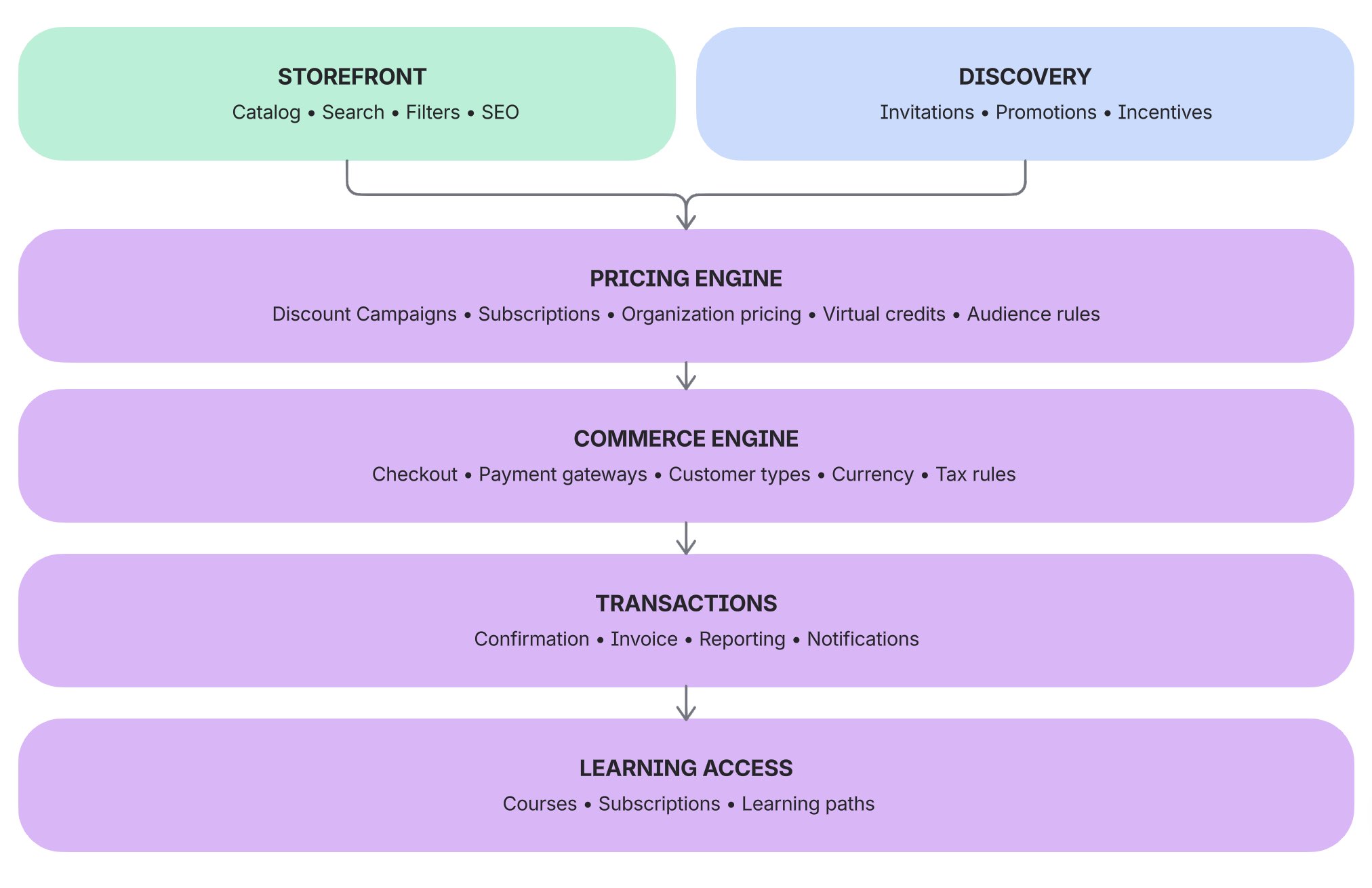
Visual structure: The Eurekos Learning Commerce Ecosystem
An integrated system connects training discovery, pricing strategies, purchasing workflows, and learning access. Rather than relying on separate systems for catalog management, commerce, and learning delivery, these capabilities operate together through shared user profiles, centralized data, and consistent configuration options. This architecture enables organizations to manage pricing, distribution, access control, and transactions in a coordinated way while maintaining a seamless experience for learners.
The diagram below illustrates how these components work together within the Eurekos learning commerce ecosystem.
Example Commerce Scenarios
The Eurekos commerce ecosystem supports a wide range of commercial and operational training models. The examples below illustrate how different platform capabilities can work together to support common learning business scenarios.
Scenario 1: Selling Courses Directly To Individuals
A training provider offers professional courses that individuals can purchase directly through the storefront.
| Step | Platform capability |
|---|---|
| Discovery | Users browse courses in the Storefront |
| Pricing | Courses have fixed prices and optional Discount Campaigns |
| Checkout | Users complete purchases using card payments or wallets |
| Transaction | The platform generates order confirmations / invoices |
| Learning access | Users gain immediate access to the course |
This model is commonly used by:
- Professional training providers
- Certification programs
- Online course businesses
Scenario 2: Corporate Training For Enterprise Customers
An organization sells training programs to companies that enroll multiple employees.
| Step | Platform capability |
|---|---|
| Discovery | Companies access training through the Storefront or Invitations |
| Pricing | Organization-level discounts or negotiated pricing |
| Checkout | Companies enroll employees/customers using Invoice payment |
| Transaction | The platform records transactions and generates documentation |
| Learning access | Employees/customers receive access to assigned training programs |
This model supports:
- Corporate training programs
- Partner training programs
- Enterprise learning agreements
Scenario 3: Subscription-based Learning Library
A training provider offers unlimited access to a catalog of courses through a subscription.
| Step | Platform capability |
|---|---|
| Discovery | Users browse the catalog in the Storefront |
| Pricing | Access controlled through Subscriptions |
| Checkout | Users subscribe using supported payment methods |
| Transaction | Recurring transactions are recorded |
| Learning access | Subscribers access all included courses |
This model is often used for:
- Learning libraries
- Membership organizations
- Professional associations
Scenario 4: Partner Training Funded Through Credits
An organization allocates training credits to partners or departments that can be used to enroll in training.
| Step | Platform capability |
|---|---|
| Discovery | Partners browse training through the Storefront |
| Pricing | Activities are priced normally |
| Checkout | Purchases are completed using Virtual credits |
| Transaction | Credit usage is recorded in transactions |
| Learning access | Users gain access to the training |
This approach allows organizations to control training budgets while maintaining flexible enrollment.
Scenario 5: Marketing Campaigns and Promotional Access
Training providers may run marketing campaigns to attract new learners or promote specific programs.
| Step | Platform capability |
|---|---|
| Discovery | Campaigns direct users to the Storefront |
| Pricing | Discount Campaigns or coupon codes |
| Engagement | Invitations, promotions, or incentives |
| Checkout | Users redeem discounts during purchase |
| Learning access | Users enroll and begin training |
This model is commonly used for:
- Webinar promotions
- Conference campaigns
- Limited-time course discounts