Introduction to Subscriptions - Article
Summary
Subscriptions in Eurekos provide continuous access to evolving learning content rather than one-off course purchases. They enable scalable learning delivery for individuals and organizations while supporting recurring learning models for compliance, professional development, product training, and partner enablement.
In this article you will learn:
- How subscriptions support continuous access to evolving learning content
- How subscription models enable compliance, professional development, and product training
- How personal and team subscriptions support individual and organizational access
- How subscriptions support scalable learning delivery and recurring learning engagement
Subscriptions as Living Knowledge Environments
Rather than acting as static course catalogs, subscription-based learning platforms function as living knowledge environments. Content can be updated, expanded, and refined over time, allowing learners to return as their roles, responsibilities, and knowledge needs evolve. This is especially valuable for domains where information evolves quickly, such as product training, compliance, professional development, and technical specialization.
The Role of AI in Subscription Learning
AI significantly amplifies the value of subscriptions by helping learners navigate large and growing content libraries. Within a subscription model, AI can:
- Surface relevant content based on context, behavior, and learning history
- Enable search and conversational access to proprietary knowledge
- Support just-in-time learning, guiding users to what they need at the moment of need
- Increase engagement by reducing friction and cognitive overload
When combined with continuously updated content, AI transforms subscriptions into an always-available expert layer—making learning faster, more personalized, and more actionable.
From an organizational perspective, this fundamentally changes how learning content is created, maintained, and delivered. Instead of forcing every new piece of knowledge into a rigid instructional design process, subscriptions enhanced with AI allow content to evolve incrementally and become immediately available within the knowledge ecosystem.
New materials such as standard operating procedures, short explainer videos, or focused technical updates can be added as independent assets that immediately enrich the overall knowledge offering. There’s no need to redesign the entire structure each time something changes. This dramatically improves speed to market, reduces overhead, and enables continuous improvement rather than constant rebuilding.
It also transforms content curation. Knowledge can be surfaced proactively (based on profile, role, or behavior) or reactively (driven by questions and searches from subscription members). The result is a flexible structure with less rework, more incremental enhancement, and far greater efficiency—delivering more personalized, need-driven learning and better outcomes for both learners and the organization.
While the advantages and efficiencies are clear, this does not mean you should abandon formal, controlled certification programs. In many real-world scenarios—such as compliance, regulatory requirements, or structured skill development—a well-defined program that guides learners from A to Z is essential.
However, subscriptions introduce a fundamentally different level of flexibility and scalability, complementing structured programs by allowing knowledge to evolve continuously and be accessed as needed.
A Long-term Value Proposition
Subscriptions in Eurekos represent more than a billing mechanism—they are a strategic framework for delivering learning continuously and at scale.
Modern learning organizations increasingly move away from one-time course sales toward ongoing access models that support continuous development, compliance training, product enablement, and partner education. Subscription-based learning enables organizations to deliver evolving content libraries while maintaining predictable revenue streams and long-term customer relationships.
In this model, learning is not purchased as isolated activities but accessed as part of a growing training ecosystem that expands with organizational needs. Combined with AI-assisted discovery, structured learning paths, and flexible packaging, subscriptions support a modern learning strategy where knowledge evolves alongside people, products, and industries.
Subscriptions therefore function both as a commercial model and an operational learning delivery framework, enabling organizations to scale learning programs while maintaining administrative simplicity.
Strategic Focus on Subscriptions
Eurekos treats subscriptions as a native, first-class capability deeply integrated with the platform’s commercial infrastructure. Rather than functioning as an isolated payment feature, subscriptions work seamlessly across the entire commercial workflow—from presentation in the storefront to purchase, enrollment, seat allocation, and learning access management.
Audience targeting, storefront configuration, subscription packaging, and learner access control operate within the same unified system. This allows organizations to deliver subscription-based learning experiences that are consistent across customer segments, regions, and delivery channels.
The platform is designed to support complex global learning businesses while keeping administration manageable. Eurekos supports flexible billing structures including:
- Monthly, quarterly, and annual billing models
- Multi-currency pricing for international markets
- Automated tax handling across jurisdictions
- Subscription lifecycle management including renewals and reactivations
These capabilities allow organizations to scale subscription-based learning offerings globally without introducing unnecessary operational complexity.
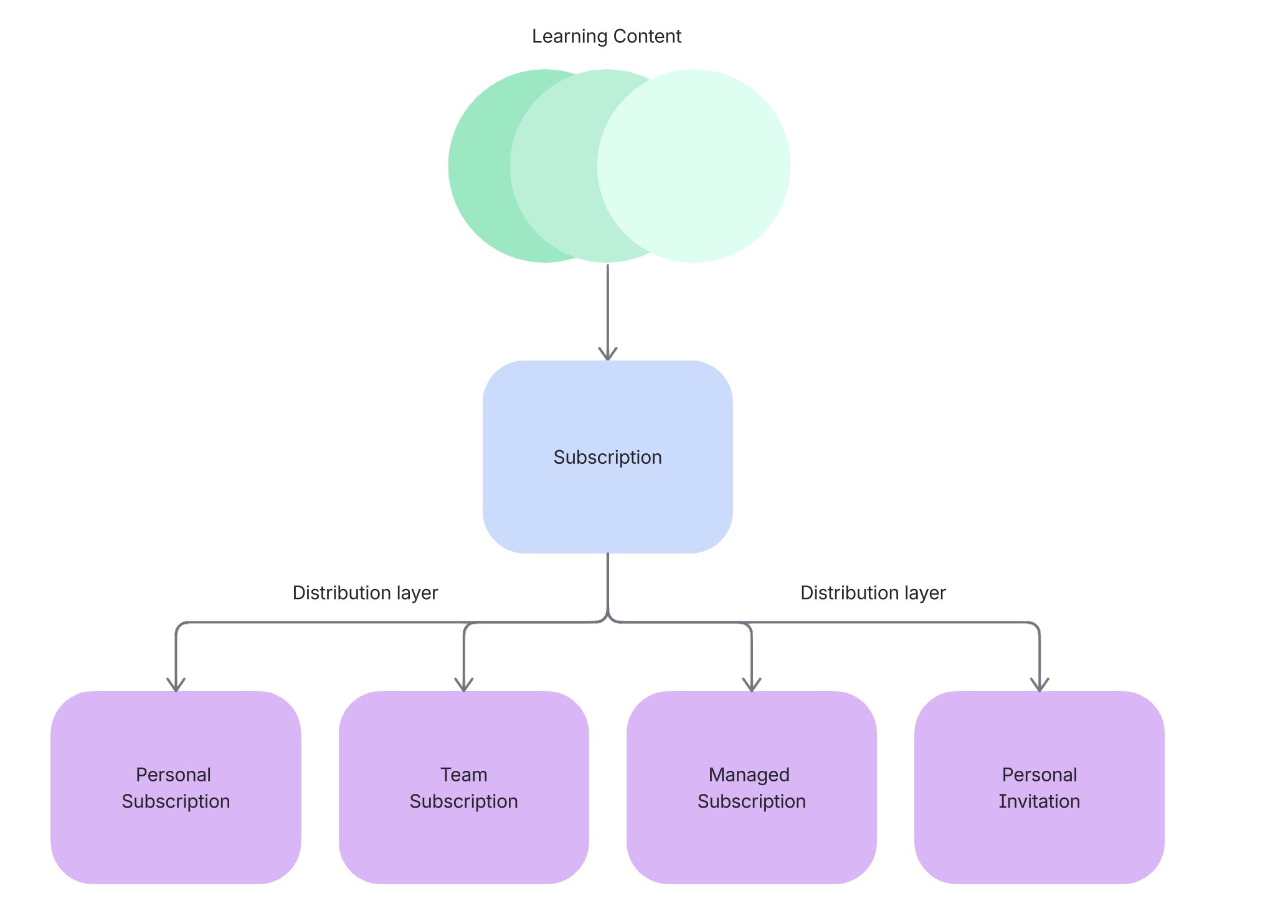
Subscription Models in Eurekos
Eurekos supports several subscription models designed to address different learning and commercial scenarios.
Personal Subscriptions
Personal subscriptions provide individual learners with direct access to a curated training catalog.
Learners purchase access themselves through the storefront and manage their subscription independently. This model supports self-service learning access, recurring engagement, and scalable distribution of training programs to individuals.
Personal subscriptions are commonly used for:
- Professional development programs
- Continuing education offerings
- Individual certification preparation
- Open training catalogs
Team Subscriptions
Team subscriptions allow organizations to purchase learning access for groups of learners using a seat-based model.
A subscription owner manages access for the organization by assigning seats to users, inviting learners, transferring seats when needed, and monitoring training participation.
This model supports centralized organizational control while maintaining flexible learner access. Team subscriptions are typically used for internal training programs, partner enablement, and enterprise learning initiatives.
Key capabilities include:
- Seat assignment and transfer between learners
- Invitation workflows for team members
- Centralized billing and subscription management
- Monitoring of learner participation and progress
Managed Subscriptions
Managed subscriptions extend the team subscription model to support enterprise procurement and negotiated commercial agreements.
Instead of relying solely on online checkout, managed subscriptions allow administrators to create subscription access for organizations based on invoicing, purchase orders, or other external billing arrangements.
This model is particularly useful for enterprise and extended-enterprise training environments where purchasing processes require negotiated pricing, centralized procurement approval, or contractual billing structures.
Managed subscriptions enable organizations to:
- Deliver negotiated subscription agreements to customers
- Support invoicing and purchase order workflows
- Maintain external billing arrangements while managing access internally
- Provide seat-based access for large learner groups
Once created, the subscription owner manages learner access in the same way as a standard team subscription, while administrators maintain control over the commercial agreement and billing parameters.
Flexible Commercial Workflows
In addition to standard subscription purchasing, Eurekos supports commercial flexibility through features such as personal subscription invitations and negotiated pricing workflows.
These capabilities allow administrators to offer customized subscription prices to specific individuals or organizations without altering the standard subscription configuration visible in the storefront.
This approach allows learning businesses to support:
- Negotiated enterprise agreements
- Partner pricing models
- Promotional or pilot programs
- Customer-specific subscription offers
By separating standard subscription configurations from negotiated commercial conditions, Eurekos enables organizations to maintain pricing integrity while supporting real-world sales processes.
Global Tax Management Within Subscriptions
Subscriptions are fully integrated with the Eurekos e-commerce infrastructure, including global tax management.
The platform supports automated tax calculation during checkout based on configured tax rules such as VAT or GST, ensuring that transactions reflect the correct tax treatment for learners purchasing from different regions.
Organizations configure their own tax rules and rates based on local legal requirements, while Eurekos provides the framework to apply these settings consistently across course purchases, subscription transactions, and other commercial activities.
This ensures that invoices, receipts, and financial records reflect accurate tax handling for international training businesses.
Common Subscription Use Cases
The following examples illustrate how subscription models are used to deliver learning at scale. Each scenario highlights both the business outcomes subscriptions enable and the Eurekos capabilities that support them.
Continuous Professional Development & Role-based Learning
Modern learning is rarely a one-time event. Skills evolve continuously as technologies, regulations, and professional practices change. Subscription models support this reality by allowing learners to revisit and expand their knowledge over time.
Subscriptions enable organizations to deliver ongoing professional development rather than isolated training events, allowing learners to build deeper expertise as their roles evolve.
This is supported in Eurekos through capabilities such as:
- Dynamic learning hubs where content can be updated and expanded continuously
- AI-assisted discovery and search that surfaces relevant content based on user roles, behavior, and context
- Personalized learning journeys that evolve alongside a learner’s career progression
Example: An engineer working in renewable energy can repeatedly access updated technical modules as industry standards evolve, without needing to purchase new training programs each time knowledge changes.
Certification Programs & Ongoing Compliance
In regulated industries, learning must often support structured certification programs while ensuring that knowledge remains current.
Subscriptions allow organizations to combine formal certification pathways with ongoing knowledge reinforcement, enabling learners to maintain compliance over time rather than treating training as a periodic obligation.
Eurekos supports this model through capabilities such as:
- Certification programs embedded within subscription libraries
- Compliance tracking and reporting dashboards
- Automated reminders and re-enrollment rules when certifications expire
This approach allows organizations to maintain continuous oversight of certification readiness across learner populations, particularly valuable in sectors such as healthcare, manufacturing, and financial services.
Customer, Partner & Reseller Enablement Worldwide
Organizations increasingly rely on distributed ecosystems of partners, resellers, and customers who require consistent product and service knowledge.
Subscriptions provide a scalable model for delivering structured enablement programs to external audiences across regions and languages.
Eurekos supports this through capabilities such as:
- Audience segmentation and multi-tenant distribution models
- Storefront tailoring for different customer or partner groups
- Localization and multi-language learning delivery
This allows training to function as a strategic extension of the product or service offering, rather than simply an internal operational activity.
Example: A software company offers a global reseller subscription that includes product certification, sales enablement training, and updates aligned with each product release.
Product & Solution training that Evolves with Releases
Products evolve continuously, and training must evolve alongside them. Subscription models make it possible to treat product knowledge as living documentation rather than static course releases.
Subscriptions enable organizations to maintain evergreen training libraries that grow with each product iteration.
Eurekos supports this through capabilities such as:
- Modular content updates without restructuring existing learning programs
- Content tagging by product version or feature area
- AI-powered search and discovery that connects learners with the most relevant resources
Rather than releasing separate training programs for each product version, organizations can maintain continuously updated learning environments that accelerate product adoption and reduce support friction.
Team-Based Access with centralized Seat & License Management
Enterprise learning programs require centralized oversight while allowing flexible access across teams and departments.
Subscriptions support this model by allowing organizations to manage learning access through seat allocation rather than individual course purchases.
Eurekos enables this through capabilities such as:
- Centralized seat allocation and bulk management tools
- Transferable seats that can be reassigned as roles change
- Reporting on individual and team learning activity
This approach reduces administrative overhead while ensuring that learning access remains aligned with organizational priorities.
Example: A multinational organization assigns subscription seats to regional teams and reallocates them as projects evolve, without requiring constant administrative involvement.
Business & Operational Advantages
In addition to the learning scenarios described above, subscription models provide significant internal business advantages. From an operational perspective, they improve efficiency, scalability, and long-term management while supporting sustainable growth in learning delivery.
Predictable Revenue that Supports Content Investment
For organizations delivering training commercially, subscriptions transform learning into a sustainable business model rather than a series of one-off transactions. Recurring subscription revenue creates predictable income streams that support long-term investment in content quality and knowledge development.
Eurekos supports this model through capabilities such as:
- Flexible billing cycles including monthly, quarterly, and annual subscriptions
- Tiered pricing and scalable subscription packaging
- Multi-currency pricing and global tax management
This alignment between revenue and content development enables organizations to build continuously improving learning ecosystems rather than static course catalogs.
Global Scalability and Simplified Administration
Delivering training globally introduces operational complexity across currencies, tax jurisdictions, and learner populations. Subscription models simplify these challenges by decoupling learning access from individual transaction management, allowing organizations to scale their learning offerings more efficiently.
Eurekos supports global subscription delivery through:
- Multi-currency pricing and automated tax calculation
- Audience segmentation by geography or customer group
- Role-based administration for enterprise and partner organizations
This infrastructure enables learning providers to scale internationally while maintaining consistent operational control.
Higher Retention and Engagement
Traditional training purchases often lead to short-term engagement. Subscription models encourage learners to return regularly as content evolves and new knowledge becomes available.
Subscriptions enable organizations to create ongoing learning relationships rather than isolated training interactions.
Eurekos supports engagement through capabilities such as:
- AI-driven recommendations and contextual learning discovery
- Category-based subscription navigation and content exploration
- Flexible enrollment rules that adapt learning journeys over time
This continuous engagement helps transform learning into a long-term habit, supporting deeper skill development and more meaningful learning outcomes.