Understand AI Providers, Data Processing, and Governance - Article
Summary
AI governance is a practical information-management decision. Organizations need to know which service processes their material, what context may be sent to it, who owns the configuration and how generated answers should be used.
Eurekos combines controlled content retrieval with a managed AI service and safeguards for generated responses. Understanding how permissions, grounding, provider processing and stored records fit together helps you assess the service confidently and set appropriate expectations for learners. This article explains the default Microsoft-hosted arrangement and the boundaries to review when choosing another supported configuration.
Use this article to:
- Understand the main AI processing stages
- Separate learning access from provider and logging arrangements
- Identify deployment questions for Eurekos and internal governance owners
- Prepare safe rollout and support practices
Understand the supported provider choice
Eurekos offers and uses Microsoft Azure OpenAI as the default assistant configuration, with Microsoft’s standard guardrails configured. OpenAI models run through Microsoft’s Azure service. This is separate from using a personal ChatGPT account or connecting directly to OpenAI’s public API.
Eurekos also offers a direct OpenAI connection, alongside supported configurations based on Claude (Anthropic) and Gemini (Google). Microsoft-hosted OpenAI and direct OpenAI are different service routes, even when they use models from the same model family. Eurekos also supports Claude through Microsoft Foundry and Gemini on Google infrastructure. Eurekos manages the provider connection, supported model and associated technical configuration. Contact your Customer Success Manager or Eurekos Support to agree an alternative or review your platform’s actual setup.
With a direct OpenAI connection, requests go to OpenAI’s service rather than Microsoft’s Azure service. The Azure-specific data protections described below apply to the Microsoft-hosted route. Review the applicable OpenAI API data controls and the agreed Eurekos configuration for direct OpenAI processing, storage and retention.
Provider choice can affect response behaviour, model capabilities and processing arrangements. Confirm the enabled model, endpoint, deployment geography and applicable terms for your platform. Availability of a supported model does not mean that every model version or customer-supplied endpoint can be connected.
Audio transcription, text translation, content extraction, suggested questions and conversational answers can use different services or provider connections. Choosing the chat provider does not automatically define every other AI or language-processing service.
Understand the processing flow
- A user sends a question and the conversation supplies relevant context.
- Eurekos establishes the user’s permitted content scope. The model can request learning or discovery information through controlled platform functions; not every message needs a new search.
- Permitted retrieved material can be included with the request sent to the configured model so it can generate an answer.
- The platform presents the structured answer and connects source references to the relevant learning resources. Chat history and temporary diagnostic records have separate storage lifecycles.
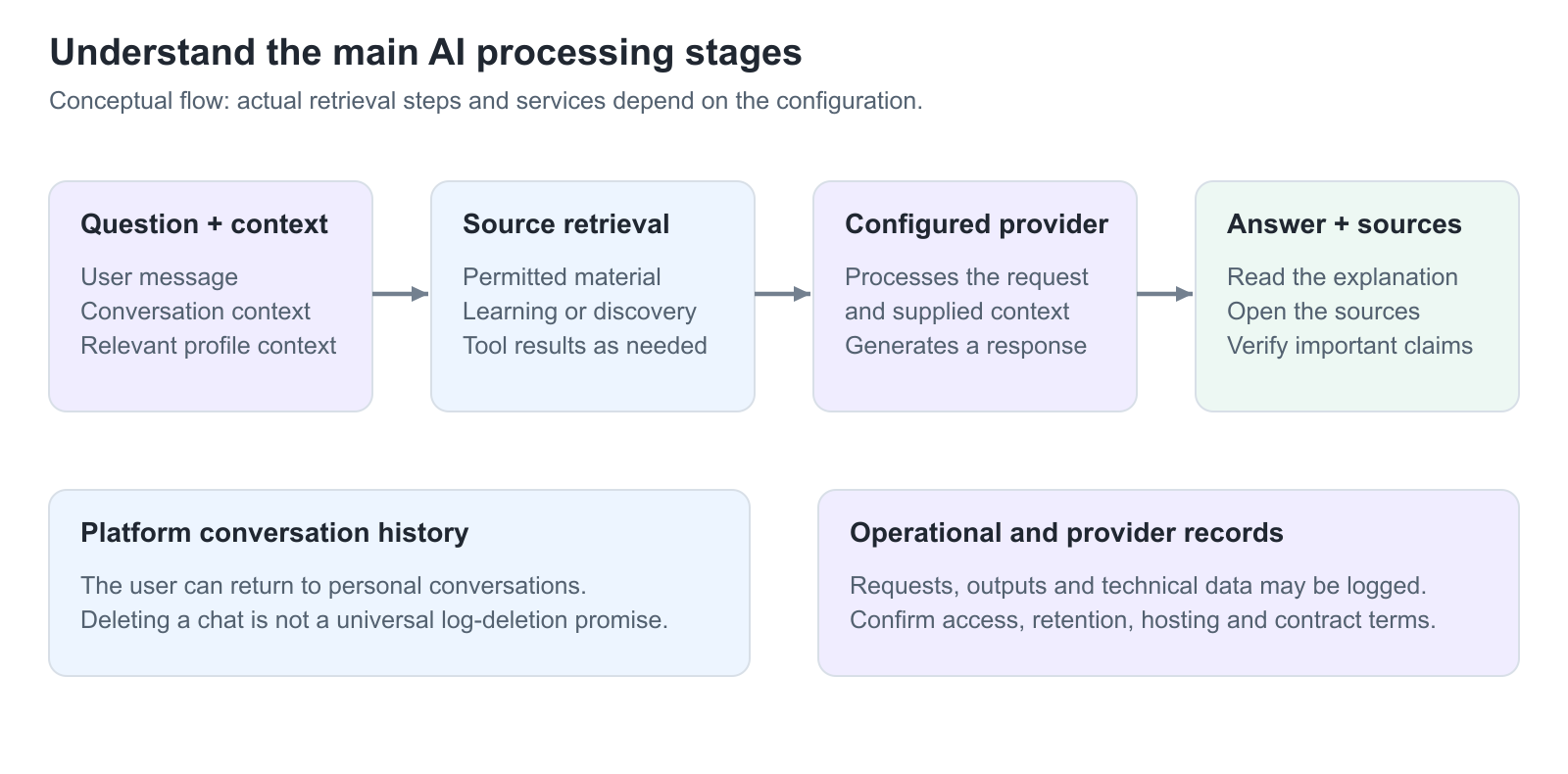
How controlled retrieval grounds an answer
Eurekos uses retrieval-augmented generation (RAG) with function calling. RAG supplies relevant source material to the model so an answer can be based on your learning content. Function calling lets the model request a supported search or training overview when needed. Eurekos executes that function within the user’s permitted scope; the model does not receive unrestricted access to the platform.
The platform enforces permissions before returning search results. Depending on the user’s relationships and the configured visibility rules, the scope can include enrolled learning, eligible Storefront descriptions, courses they author or co-author, and courses connected to activities or modules for which they are Responsible. Administrative Global Search visibility does not automatically become AI answer access. A Storefront recommendation can describe an eligible offer without revealing its restricted lesson content.
Elasticsearch provides the shared indexing and retrieval layer. Content has a plain-text representation for search and a structured representation for assistant processing and grounding. Standard document processing extracts searchable text from supported files. H5P and SCORM need additional AI-assisted extraction because their internal learning content does not have one consistent structure.
Indexing, extraction and suggested-question generation can process source material before any learner asks a question. For example, generating content-based suggestions can send an eligible page to the configured model. Review these preparatory services as well as the conversation service when deciding which material is approved for processing.
Content owners can control H5P and SCORM inclusion. Keep assessments and answer keys out of the assistant’s content scope where required: indexed quiz content can be used to answer questions. Changing the general indexing default does not automatically remove previously indexed content; affected objects must be re-saved or re-indexed. Use Control AI Content Indexing and Protect Assessments for the procedure and verification checks.
Understand Microsoft guardrails and answer confidence
The default Azure OpenAI service combines Microsoft’s standard safety controls with Eurekos-managed instructions and retrieval grounding. These safeguards address different risks. A content-safety filter can block harmful material, while grounding helps keep an answer aligned with the sources supplied to the model. Neither replaces the platform’s permission checks.
| Safeguard | What it contributes | Important boundary |
|---|---|---|
| Microsoft content-safety filters | Checks prompts and generated responses for hate, sexual content, violence and self-harm; the standard medium threshold filters medium- and high-severity content | A safety decision does not establish factual accuracy or decide which courses a learner may access |
| Grounding and vendor mechanisms | Combines retrieved learning sources with the supported vendor grounding mechanisms configured for the service to reduce unsupported or fabricated answers | Dedicated groundedness checks are separate from standard harm filters and depend on the model, deployment and enabled configuration |
| Managed instructions and source references | Guides the assistant’s use of supplied information and connects answers to original learning resources | Instructions and citations improve traceability but do not guarantee a complete or correct answer |
| Additional provider protections | Microsoft offers controls such as prompt-attack detection and protected-material detection alongside its standard harm filters | Advanced controls, including indirect document-attack detection, are not all enabled merely because the standard guardrails are used |
Vendor-provided grounding mechanisms complement Eurekos’ retrieval design. Microsoft also offers a dedicated groundedness detector that compares generated text with supplied sources. This is an additional configuration-dependent capability, not another name for the standard safety filter. Refer to Microsoft’s content-filter documentation and groundedness documentation for the distinction. Eurekos manages the supported deployment configuration; customer availability controls do not expose these technical policies.
These measures mitigate hallucinations, meaning plausible statements that are inaccurate or unsupported by the sources. They do not eliminate the risk. An answer can still be incomplete when source material is missing, outdated or extracted without enough context. Check the original source for important decisions, and use the human-support route when an answer is uncertain.
Distinguish the information involved
| Information | Why it may be processed | Governance consideration |
|---|---|---|
| Question and conversation context | To interpret the request and maintain a coherent conversation. | Tell users not to paste credentials, unnecessary personal information or confidential material outside the approved use. |
| Permission and source scope | To determine which learning resources the platform may retrieve | Access checks take place in Eurekos; the standard assistant flow does not automatically send user-profile attributes as model context |
| Retrieved source material | To ground the response in accessible learning and discovery content. | Review classification, copyright, assessment exclusions and whether the material is suitable for the configured service. |
| Platform chat history | To let the user return to their own conversations. | Define retention and deletion expectations; distinguish chat deletion from other records. |
| Operational processing logs | To diagnose requests, errors, model interactions and usage. | Authorized logs can contain input, retrieved context, outputs and technical identifiers. Restrict access and avoid unnecessary copies. |
Separate model state, chat history and diagnostic records
A stateless model does not mean a system with no stored data. Microsoft describes Azure model inference as stateless: prompts and responses are not stored inside the model or used to update its base knowledge. The surrounding service can still retain records to deliver features or monitor abuse, and Eurekos maintains its own application records.
Platform chat history: Eurekos stores the user’s conversations until the user deletes them. Each chat is independent, and starting a new chat does not bring in the conversation history from another chat. Deleting a chat removes that conversation from the assistant’s available history. It is not a request to erase every diagnostic, backup or provider-side record.
Temporary diagnostic records: Eurekos monitors model usage, token consumption, execution time and errors. For troubleshooting and quality analysis, detailed records can include context, function calls, retrieved content, instructions and generated responses. These diagnostic records are automatically deleted after 30 days. This period applies to those temporary processing records, not to the learner’s saved chat history. Access to diagnostic records is restricted to authorized technical personnel.
Provider-side records: Microsoft’s service-level storage and abuse-monitoring arrangements are separate from Eurekos chat history and diagnostic retention. Optional stateful features and the actual deployment configuration can affect what the provider stores. Neither the term stateless nor the Eurekos 30-day diagnostic policy establishes universal zero data retention.
Understand Azure data protection and deployment boundaries
In Eurekos’ default Azure OpenAI arrangement, prompts, retrieved material and generated responses are not used to train, retrain or improve foundation models. Microsoft hosts the models within the Azure service boundary; this content is not available to OpenAI or other Azure customers. These protections concern the Microsoft-hosted service and should not be assumed to describe every alternative provider connection.
Permission checks remain within Eurekos. In the standard assistant flow, user-profile attributes are not automatically supplied as model context. However, text that a user types or content retrieved from a learning resource can itself contain personal or confidential information. The service is not a universal anonymization tool: approve suitable sources and avoid unnecessary personal data, credentials and restricted material in questions.
Confirm the actual deployment geography and terms with Eurekos when your organization has residency or contractual requirements. A Microsoft-hosted model does not by itself promise one particular region: Azure’s regional, Global and DataZone deployment options have different processing-location rules. Microsoft’s data, privacy and security documentation explains the service boundaries, model state and provider-side processing arrangements.
Agree the operating model before rollout
| Question to resolve | Who should confirm it |
|---|---|
| Which provider, model and supporting services are enabled? | Eurekos technical owner or Customer Success Manager, together with the organization’s service owner. |
| Where is data processed and under which terms? | Eurekos and the organization’s privacy, security and contractual owners. |
| Which content is approved for extraction and answers? | Learning-content owners, assessment owners and information-governance stakeholders. |
| Who can access records, and which retention policy applies to each type? | Eurekos and the organization’s service owner, distinguishing saved chats, 30-day diagnostic records and provider-side arrangements |
| How will errors and sensitive-content incidents be handled? | Support and the organization’s operational owner, with a clear learner reporting route. |
Use safe examples and a human escalation route
Test with realistic but non-sensitive content. A useful support report states the affected feature, safe source location, user role, approximate time and expected versus actual result. Do not paste a real exam answer key, an API key or private personnel material into a demonstration question to prove a point.
Generated guidance should not be treated as an official assessment decision, legal opinion or authorization to take a safety-critical action. Users should verify important information in the original source and contact the responsible person when an answer is uncertain.
For the practical settings and content checks, use Configure Saga Availability and Access and Control AI Content Indexing and Protect Assessments.
Troubleshooting
| Problem | What to check |
|---|---|
| A stakeholder asks where data is hosted | Confirm the actual deployment and services with Eurekos. Do not infer a region or contractual guarantee from the provider name. |
| A user expects chat deletion to erase every log | Explain the difference between platform conversation history and operational/provider records, then confirm the applicable deletion and retention process. |
| An answer reveals unsuitable source material | Identify the actual source, review access and usage settings, reprocess affected content where required and follow the incident route. |
| A provider option shown elsewhere is unavailable | Supported models and configuration permissions can differ. Ask the technical owner rather than creating an unsupported connection. |
| A legitimate learning question is blocked | Microsoft safety controls may have filtered the prompt or response. Provide Eurekos Support with a safe example and the time of the request; do not broaden permissions or disable safeguards to bypass the result |
| An answer is fluent but does not match its source | Check the cited passage and whether the source is current and sufficiently indexed. Report the mismatch; a citation or safety-filter pass does not certify factual accuracy |
| Someone assumes stateless means no stored records | Distinguish model inference from saved chats, 30-day diagnostic records and provider-side storage or monitoring |
FAQ
-
Does the provider name prove where all data is stored?
No. Hosting, region, services, retention and contractual terms must be confirmed for the actual deployment.
-
Does deleting my chat delete provider logs too?
Do not assume so. Platform conversation history and operational or provider processing records are separate; the applicable retention and deletion arrangements must be confirmed.
-
Are text translation and audio transcription the same service as chat?
Not necessarily. They can use different services, supported language catalogues and processing arrangements. Confirm the enabled services rather than applying one provider statement to all AI features.