Monitor Feedback and Maintain a Trustworthy Knowledge Base - Article
Summary
A Knowledge Base remains valuable when its guidance continues to solve real problems. Publishing is the start of an operating responsibility: content owners need to identify confusing explanations, update changed processes and preserve the routes people already use.
Combine article feedback with recurring support questions and targeted reader checks. Popularity and AI usage help identify attention, but they do not prove that a problem was resolved or a person learned the material.
Use this article to:
- Interpret article feedback and readership signals
- Maintain links, audiences and source quality through changes
- Understand public discovery and its security boundaries
Use feedback to choose what to improve
Signed-in LMS readers can mark an article as helpful or not helpful. Use the article list’s rating information to identify pages worth reviewing, then inspect the process and the actual reader questions. Anonymous visitors and Help Center administrators do not submit the same reader feedback.
A negative mark is a signal rather than a diagnosis. The procedure might be unclear, the reader might lack access to a prerequisite or the page might answer a different question from the one implied by its title. Investigate before rewriting the article or broadening its audience.
| Signal | Useful interpretation and response |
|---|---|
| Repeated not-helpful feedback | Check scope, missing prerequisites, exact steps and whether the expected result can actually be recognized |
| The same support question keeps returning | Add the missing explanation to its authoritative article and attach a concise FAQ where useful |
| High Trending or Most visited position | Review an important or frequently needed page; high visits do not prove successful resolution |
| Low apparent readership | Check discoverability, links, audience and whether the task actually generates demand |
| An AI answer repeatedly misses a condition | Improve the source section and retest the affected question rather than patching only the response |
Trending reflects the last 30 days of recorded visits; Most visited reflects the broader recorded period. Anonymous visits are excluded from those popularity measures. Treat them as navigation signals, not a complete report of public demand, unique users or support outcomes.
Keep a practical maintenance rhythm
Assign a business owner to each important process and agree when it needs review: after a policy change, a product change, a support escalation pattern or a planned periodic check. Keep owner and review records in your team’s editorial process if the Help Center does not provide a field for the information you need.
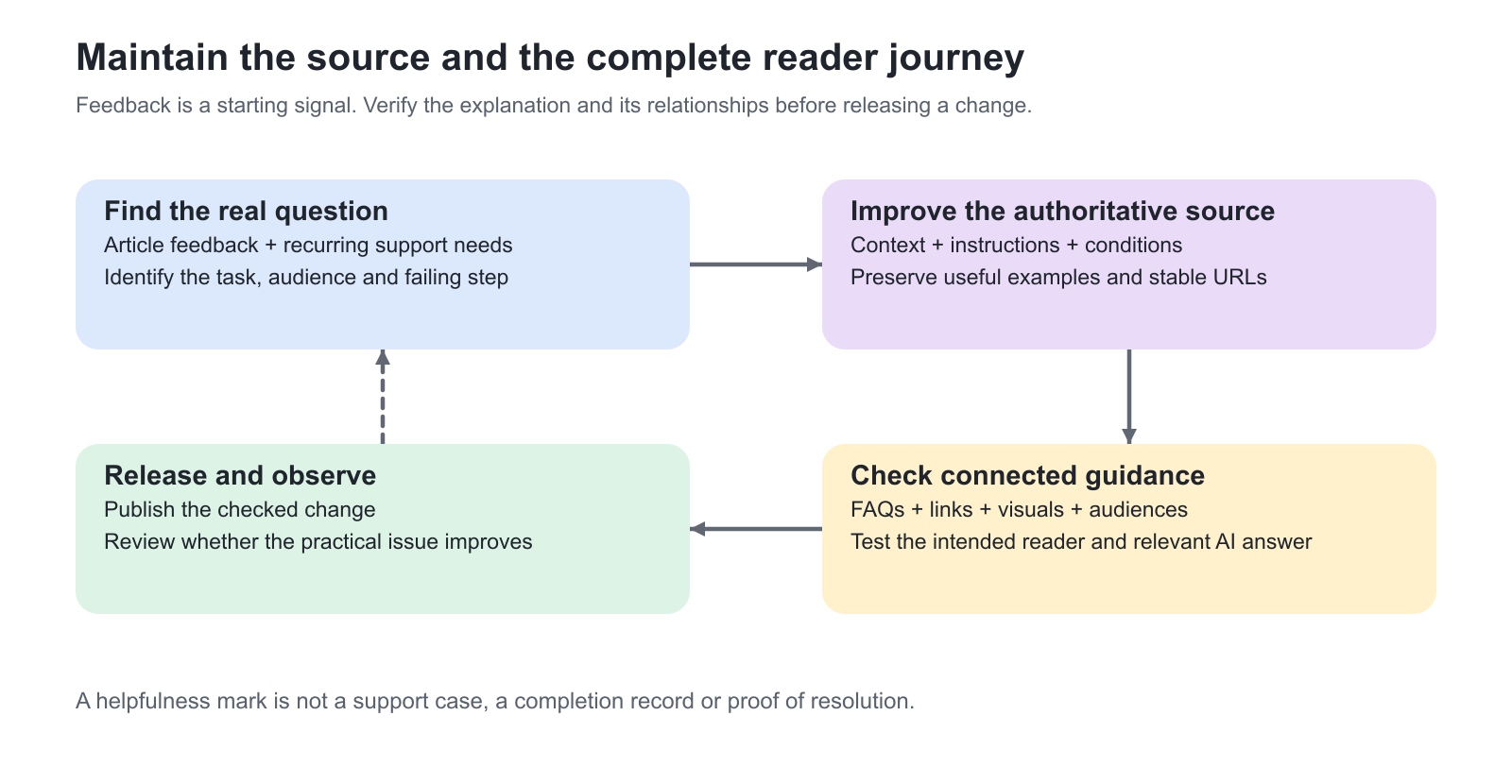
Update the existing article when its purpose remains valid. Preserve useful examples, explanations and stable URLs while correcting materially wrong information. Review attached FAQs, screenshots, Related articles and incoming links as part of the change; the body text is only one part of the reader journey.
When a page is renamed, search for the old title and URL in the affected content. A valid destination can still have misleading link text. When retiring an article, move useful knowledge to its correct owner and update the references before deleting it. Deletion does not rewrite backlinks automatically.
Understand public discovery
Published content assigned to Public user or Website AI Assistant can be eligible for external search and AI discovery. The production service provides structured discovery information through sitemaps, robots.txt and llms.txt, alongside page metadata.
These mechanisms help external services discover eligible content; they do not guarantee indexing, ranking or an AI recommendation. They also are not access controls. Keep confidential information behind the correct article permissions rather than relying on absence from a menu or a crawler instruction.
The public sitemap and llms.txt discovery outputs can be cached for up to six hours after generation. External search engines also have their own refresh schedules. This is separate from internal Help Center article saving, search and AI source processing: do not assume they all share the same update interval.
Use clear titles, useful descriptions, meaningful headings and authoritative current links. Avoid maintaining competing articles that give different answers to the same question. Public exposure should be a deliberate content decision, especially for material assigned to the website AI route.
Measure the outcome you actually need
If the business objective is fewer avoidable support cases, compare recurring questions and operational effort before and after improving the guidance. If the aim is adoption, check whether users can complete the relevant process. Article ratings and AI token volumes do not substitute for those outcome measures.
Use Prepare Reliable Knowledge for the Help Center AI Assistant for LLM usage and request-log diagnosis. Those reports describe AI processing, not Course progress, certification or an independently verified support resolution. Keep the measures distinct when reporting value to service owners.
Verify a maintenance change
| Scenario or check | Expected result or evidence |
|---|---|
| A process instruction changes | The article, attached FAQs and informative visuals remain consistent |
| An existing article is updated | Its established URL still reaches the correct guidance |
| A linked destination changes | Inline references and relevant Related articles use the current destination and title |
| An audience changes | Representative permitted and non-permitted readers get the intended result |
| Public discovery is intended | The content is suitable for public exposure and uses the intended audience selection |
| A recurring question drove the change | The revised source now answers the question and the relevant reader can find it |
Troubleshooting
| Problem | What to check |
|---|---|
| A popular article still generates support cases | Check whether it resolves the task, explains exceptions and supports the reader’s actual access state |
| Feedback is negative but gives no reason | Review support questions and test the complete process with representative readers |
| An external result still shows old information | Check the saved content, public eligibility and discovery caches; external refresh timing is outside the Help Center’s direct control |
| A retired page still has incoming links | Search the affected content for its old title and URL, then update the authoritative references |
| Public exposure was unintended | Correct the audience and content promptly, review website AI selections and follow the applicable incident process if sensitive material was exposed |
FAQ
-
Do Trending and Most visited include anonymous visitor activity?
Anonymous visits are excluded from those popularity measures. Trending uses the last 30 days of recorded visits; Most visited uses the broader recorded period. Neither proves successful support resolution.
-
Do robots.txt or sitemap settings protect confidential articles?
No. Discovery instructions are not access controls. Use the correct article audience and test reader access; content assigned to Website AI Assistant can be publicly accessible by direct URL.
-
Does a high article rating prove training completion?
No. Article feedback expresses whether the guidance was helpful. Training completion and certification are separate outcomes governed by their own learning configuration and evidence.