Introduction to Organizations - Article
Summary
Organizations provide the business structure for serving employees, customers, partners, members, regions, and internal teams through one Eurekos platform. They connect people, responsibilities, learning access, recognizable experiences, and commercial arrangements to the relationships your academy needs to support. Used deliberately, Organizations preserve shared standards while giving local teams the appropriate scope to support their own people, allowing the academy to grow without creating a separate learning operation—or the same administrative experience—for every audience.
In this article, you will learn:
- What Organizations help your business achieve.
- How a hierarchy supports customers, partners, regions, and local teams.
- How membership, roles, and access settings work together.
- Where to start when designing your own structure.
From a shared platform to distinct learning communities
A growing academy rarely serves one uniform audience. Employees may need mandatory learning and local management. Customers may need product education under their own brand. Partners may need certification, regional coordination, and organization-funded training. The provider still needs a manageable way to maintain standards and oversee delivery.
Creating a separate learning operation for every audience can repeat work. Giving everyone the same access can expose information or place too much responsibility with the central team. Organizations provide a structure for managing those relationships within the platform.
An organization can represent a customer company, partner, business unit, region, association, or another enduring relationship. Suborganizations represent the branches within it, such as departments, locations, or local partner teams. The structure becomes useful when it reflects who belongs together, who should manage them, and where responsibility should begin and end.
What Organizations help you achieve
| Business need | How Organizations support it | Operational outcome |
|---|---|---|
| Serve several customer businesses | Establish a recognizable organization for each customer and combine membership with the appropriate access and audience settings. | Manage different customer populations without treating them as one undifferentiated list. |
| Delegate routine administration | Give local administrators or Managers the permitted responsibilities within the relevant organizational scope. | Local teams can support their people while central administrators retain appropriate oversight. |
| Coordinate regional or partner networks | Represent the meaningful levels of the network through organizations and suborganizations. | Responsibilities and reporting can follow the business relationships rather than a collection of informal naming conventions. |
| Deliver relevant learning | Use organization membership with activity audience settings and, where configured, automatic enrollment or onboarding rules. | People can find or receive learning appropriate to their relationship with the academy. |
| Provide a recognizable customer experience | Configure organization appearance, a custom entry URL, and relevant contact arrangements where available. | Learners reach an experience that makes sense for their customer, partner, or business unit. |
| Support commercial agreements | Connect eligible members with organization discounts or use Virtual Credits where enabled. | Learning access and purchasing can support centrally funded or customer-specific arrangements. |
| Introduce capabilities selectively | Use feature-specific organization controls where supported, such as organization-level availability for Saga AI. | Pilot or provide a capability to selected audiences without making it available platform-wide. |
These outcomes depend on the relevant configuration. Creating an organization alone does not automatically enable every feature, restrict every record, or enroll its members into training.
Central standards, local responsibility
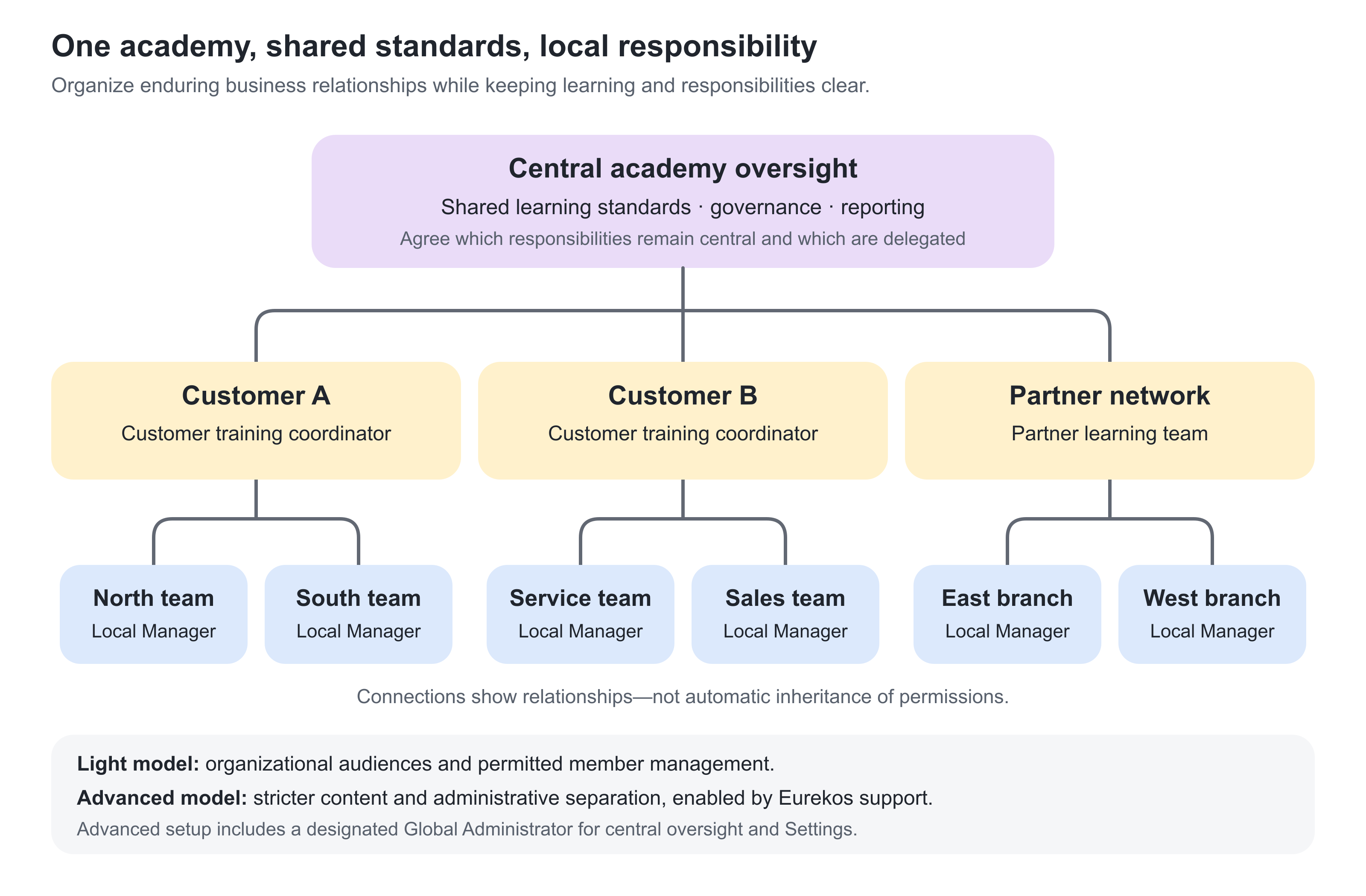
Consider a manufacturer supporting a network of distributors and service partners. The central academy maintains product learning and certification standards. Regional coordinators oversee their markets. Local partner Managers help technicians join the academy and complete the relevant training.
Organizations allow those relationships to be represented explicitly. The local Manager should not need central assistance for every permitted member-management task. Equally, that Manager should not receive wider access simply because several partners use the same platform.
The same principle applies to an internal enterprise academy. A central team can maintain common learning while local departments take responsibility for their own people. The important design decision is whether the structure supports the intended responsibilities and access boundaries.
The light organizational model supports relevant audiences and permitted member-management responsibilities while administration and shared learning remain relatively centralized. More complex academies can use advanced organizational filtering to extend separation across users, activities, content, archives, and assets. This requires deliberate ownership of shared resources and greater central oversight.
Only Eurekos support enables the advanced configuration; its controls are not initially visible to a Platform Administrator. During setup, a designated Platform Administrator is elevated to Global Administrator. In this advanced model, Global administration manages Settings, while Platform Administrators work within the stricter organizational boundaries. Organizations do not need this advanced configuration to provide value.
Understand the building blocks
| Building block | What it represents | Important distinction |
|---|---|---|
| Organization | A business or audience relationship that you need to manage. | It is more than a label, but it is not automatically a fully isolated environment. |
| Suborganization | A branch within an organization. | A branch has a place in the hierarchy; not every setting inherits in the same way. |
| Membership | A user's relationship with an organization or suborganization. | Membership is not the same as enrollment in a Training Activity. |
| Role | The types of actions a person is permitted to perform. | A role and the organizational scope of those actions are different controls. |
| Organization filter and content relationships | Organization-based access that can operate in a light model or an advanced configuration with stricter content and administrative separation. | Advanced configuration requires Eurekos support and designated global oversight. Feature-specific rules and explicit responsibilities still matter. |
| Activity audience configuration | The organizational audience intended for a training offer. | Seeing an offer is not the same as owning or being able to edit its content. |
For example, an employee can be an organization member without being enrolled in a compliance activity. A customer can have branded entry pages without every aspect of access having been configured. A local administrator may be able to support members without having permission to change platform settings.
Choose an organization model that fits the relationship
| Model | Practical design | Why it is useful |
|---|---|---|
| Customer academy | Separate customer organizations, with suborganizations for meaningful customer departments or locations. Use the appropriate audience and access settings for customer-specific offers. | Supports customer ownership and relevant learning while keeping the provider's shared academy manageable. |
| Partner certification network | Represent partners and their operating branches. Allocate local responsibilities and connect the structure to the training and reporting required for certification. | Helps partners manage participation while the provider oversees qualification standards. |
| Internal enterprise learning | Use business units, regions, or departments where they represent real management or access needs. Keep temporary course cohorts in the learning-delivery structure. | Supports local administration without continually rebuilding the organization hierarchy. |
| Professional association | Represent member organizations and local groups that have continuing administrative relationships with the association. | Allows local coordination alongside central learning standards and evidence. |
These models can coexist. A manufacturer might maintain shared product learning centrally, give each distributor its own organization, and use branches only where a regional or local coordinator has a continuing responsibility. Customer coordinators manage their people within permitted roles; access to the learning does not give them authority to edit its source. Participation can be free, paid, or funded outside the participant checkout.
Start with the relationships, not every available setting
Begin with four questions:
- Which populations need to be managed separately?
- Who should take responsibility for each population?
- What should those populations share, and what must remain separate?
- What must central and local teams be able to see or report?
Use the answers to define a small, representative structure first. Then check it with a participant, a local administrator or Manager, and the central role responsible for oversight. A structure that looks sensible on paper is only useful if those people can do the intended work.
Do not add hierarchy levels merely because the platform supports them. Each level should serve a recognizable purpose. Equally, avoid placing unrelated customers under a shared administrative branch without considering who will gain oversight of that branch.
Continue with the task you need
| Your next task | Article |
|---|---|
| Decide the hierarchy and administrative boundaries | Design Your Organization Hierarchy and Access Model |
| Create, edit, or reorganize the structure | Create and Maintain Organizations and Suborganizations |
| Add people and control membership capacity | Manage Organization Members and Member Limits |
| Choose how people join the correct organization | Invite Users and Assign Organization Membership |
| Configure the audience-facing experience | Configure Organization Branding, Contact Details, and Custom URLs |
| Understand content relationships and learning visibility | Manage Organization Content and Learning Visibility |
| Maintain the structure in bulk | Import and Maintain Organization Structures |
| Fund eligible learning through organization balances | Manage Virtual Credits for Organizations |
Organizations provide the foundation for managing a complex academy without making every learning experience complex. Build the relationships you need, assign responsibility deliberately, and enable additional capabilities where they solve a real business need.
FAQ
-
Do I need advanced organizational filtering to use Organizations?
No. The light organizational model already supports organizational audiences, permitted Manager responsibilities, and other relevant features. Advanced filtering is intended for more complex structures that also need stricter separation across content, assets, users, activities, and administration. Eurekos support enables that configuration after the required responsibilities and access boundaries have been agreed.
-
Do I need a separate organization for every Training Activity?
No. Use Organizations for meaningful business or audience relationships. Use Training Activities and their participant lists for individual deliveries or temporary cohorts unless a lasting organizational relationship is also needed.
-
Are Organizations only useful for paid customer training?
No. Organizations also support free customer education, internal learning, partner development, and centrally funded programs. Payment is not required to benefit from organization membership and permitted delegated administration.
-
Can one person belong to more than one organization?
Yes. Use multiple memberships for genuine shared relationships and review the resulting access, administration, branding, and payment context. Membership alone does not grant an administrative role or unrestricted access.