Get Started: Choose Your Implementation Path - Article
Summary
An effective learning service starts with a clear first audience and a useful outcome. You may already have a mature academy and a large portfolio, or you may be building your first training offer. Both are valid starting points; they need different implementation plans.
Eurekos connects content, training delivery, audience management, discovery, commerce and evidence. You can begin with the combination your first service needs, then expand it as your content, operating experience and business priorities develop. This series helps you turn that flexibility into an achievable plan.
Use this article to:
- Recognize your starting point and choose a suitable implementation route
- Define a first launch that delivers real value
- Understand which foundations, decisions and dependencies come first
- Combine delivery and commercial models without confusing their outcomes
- Find the planning, pilot and growth guidance relevant to your next stage
Start with a service people can use
A platform implementation is successful when a particular audience can accomplish something worthwhile and your team can operate that experience reliably. Installing every available feature is a poor substitute for that outcome. A small, complete service can create value while a broader portfolio or integration program continues in parallel.
For example, a manufacturer may initially help service partners commission a new product safely. An association may give members access to a useful learning collection. A training provider may launch a paid program with scheduled sessions and a certificate. Each needs content and access, but their purchasing, facilitation, evidence and support requirements differ.
Describe your first release in one sentence: “By our launch date, this audience can enter through this route, complete this useful training and obtain this result, with this team supporting them.” If the sentence is difficult to finish, resolve the business choices before expanding configuration.
Recognize your starting situation
Choose the situation closest to yours. You can combine several routes; the purpose is to identify the work that will determine readiness, rather than force your organization into an industry category.
| Your starting situation | A useful first scope | Begin with |
|---|---|---|
| We have an existing LMS and usable course packages | Migrate a representative set, preserve a clear identity strategy and prove the new delivery journey before moving the full portfolio | Launch with Existing Courses and Learning Assets |
| We have presentations, manuals and expertise, but little ready training | Build a small portfolio around important tasks, with a realistic production and review process | Build Your First Learning Portfolio |
| A defined population must complete required learning | Establish accurate audience data, assignment rules, completion evidence and follow-up | Launch Assigned and Mandatory Training |
| Customers or partners need relevant learning and continuing support | Launch an understandable academy entry route, a focused catalog and appropriate access boundaries | Launch a Customer or Partner Academy |
| We sell training or need business purchasing | Prove the complete offer, checkout or invoicing route, enrollment and financial handoff | Launch Paid Training and Business Purchasing |
| Members or contracted customers need ongoing access | Separate membership eligibility from the platform Subscription model, then choose the entitlement and renewal process | Launch Member Learning and Subscription Services |
| Our program depends on sessions, assessed work or credentials | Coordinate scheduling, capacity, instructor responsibilities and meaningful certification evidence | Launch Facilitated Training and Certification |
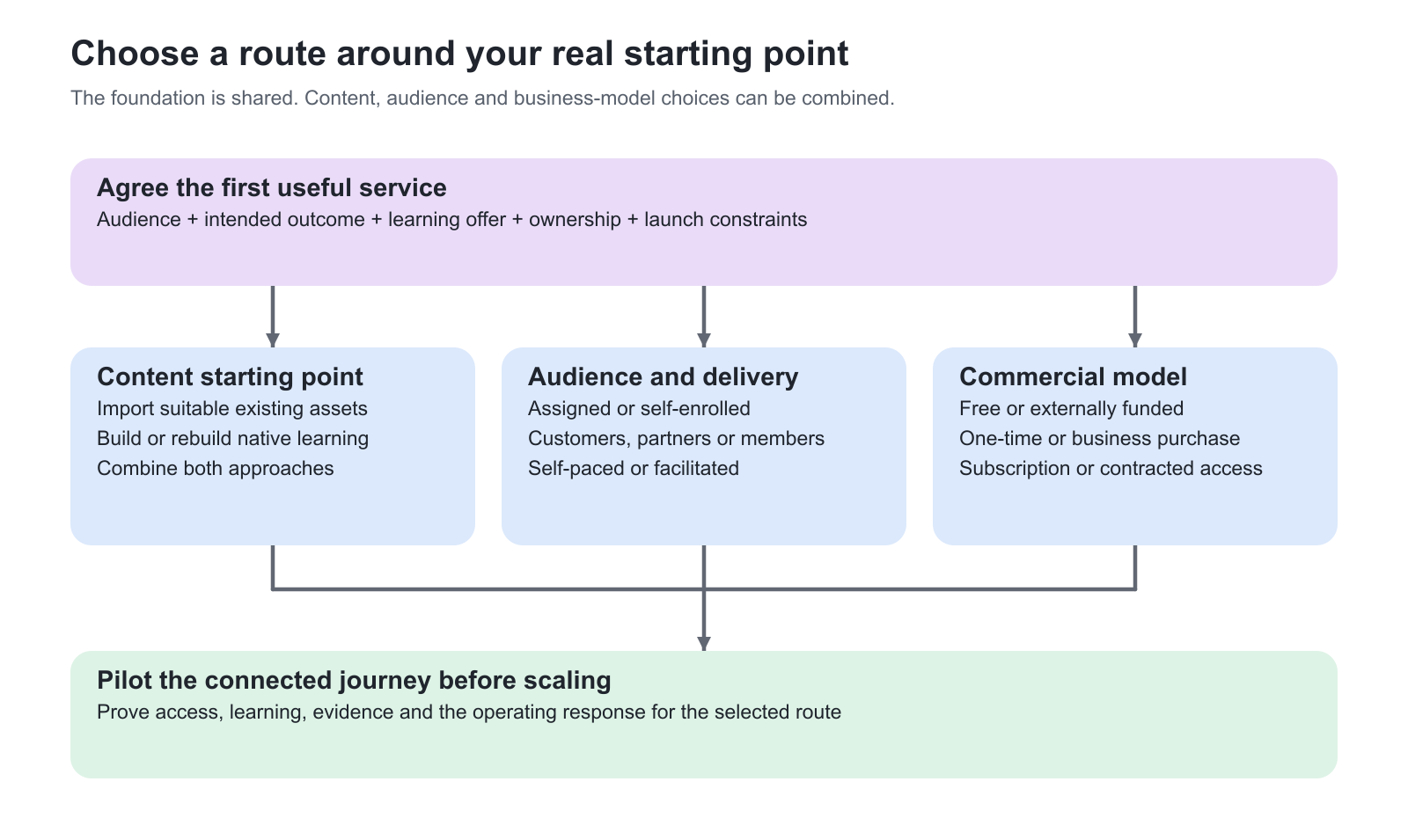
A service academy can combine assigned product onboarding, optional paid advanced training and a contracted learning library. You do not need three unrelated implementations. Establish the shared audience, identity and content foundations, then verify each distinct participant and purchasing journey.
Understand the building blocks before arranging the work
Several decisions that appear to describe “the course” actually belong to different objects. Keeping these distinctions clear prevents avoidable rework.
| Building block | What you are deciding |
|---|---|
| User account and profile | Who the person is, how they sign in and which maintained data can support targeting |
| Organization and role | Which organizational relationships and permitted responsibilities the person has; these are separate from training registration |
| Course and reusable assets | The learning content: native pages, imported packages, videos, interactions and other materials |
| Training Activity | The delivered offer: its modules, enrollment, audience, schedule, completion requirements, commercial conditions and administration |
| Storefront | How relevant offers are presented and discovered, with the configured visibility and enrollment boundaries |
| Participation and evidence | The individual enrollment, progress, attendance, assessment and certification records produced through the journey |
| Subscription or other funding arrangement | How ongoing access or a purchase is provided; this is separate from the content and from a particular learner’s completion |
The same Course can support several Training Activities with different audiences or delivery conditions. Conversely, a Learning Path can combine Courses, Events and Assignments. Start with Introduction to Content Creation and Authoring and Introduction to Course Administration when these concepts are new to your team.
Choose a complete first launch
Select the smallest scope that still proves your intended service. “One course is uploaded” is a content milestone. “A representative partner can register, find the correct offer, complete the learning and receive the intended evidence” is a working launch outcome.
Keep three boundaries explicit. First, distinguish what must work on launch day from improvements that can follow. Second, identify anything that cannot be safely substituted by a temporary process, such as a required identity or payment control. Third, assign ownership of the service after launch, including content maintenance and participant support.
| Launch decision | Practical recommendation | Reason |
|---|---|---|
| Audience | Start with a real, representative group rather than an undefined “everyone” | You can verify access, relevance and support with the people the service must serve |
| Portfolio | Choose a coherent collection that solves a recognizable need | A short complete pathway is more useful than a large catalog of unfinished or poorly described items |
| Delivery | Prove the actual mix of self-paced, facilitated and assessed learning | Each type creates different responsibilities and evidence |
| Commercial route | Include the purchasing or entitlement process in the first pilot when it is central to the business model | A free administrator test does not prove a customer’s checkout or subscription journey |
| Integrations | Put only genuine launch dependencies on the critical path | Other connections can progress in parallel when a controlled interim process is acceptable |
| Language and scale | Pilot the necessary audience and language variations, then repeat the working pattern | A successful administrator preview does not establish a multi-organization or multilingual experience |
Avoid reducing scope by removing the very condition you need to prove. If the launch depends on customers buying seats for other people, test that buyer-and-learner relationship. If the program must support renewal, include a planned review of the renewal design even when the first certificates will not expire for months.
Follow the shared implementation path
For a practical kickoff conversation and a checklist your team can adapt, use Quick Guide: Run an Implementation Kick-off and Build Your Checklist. It helps a customer core team turn the chosen route into a launch statement, named responsibilities and evidence of readiness.
- Agree the business outcome and first launch boundary. Use Plan Your First Launch and Implementation Workstreams to turn the target into owned workstreams and readiness decisions.
- Prepare the people and operating model. Use Establish Audiences, Ownership, and Access to define audience data, identity, organizational relationships and responsibilities.
- Prepare content and delivery together. Follow the existing-content or new-portfolio route, then the delivery and commercial routes that match your service.
- Coordinate the dependencies. Use Plan Integrations and Migration Dependencies and Roll Out Across Organizations, Brands, and Languages for integrations, migration, organizations, brands and languages.
- Pilot a complete journey and make a go-live decision. Use Pilot Your Learning Service and Prepare for Go-live to gather evidence from participants and operating roles.
- Review the live service and choose the next valuable improvement. Use Operate the Service and Plan the Next Stage rather than treating launch as the end of implementation.
Workstreams can overlap. Content teams can develop a representative Course while an identity specialist confirms sign-in mapping and an administrator prepares the delivery model. They still need agreed inputs: intended audience, naming, language, evidence and ownership. A dependency is not necessarily a reason to stop all other work.
Adapt the plan to the experience you already have
If you are moving a mature academy, retain the operating knowledge that already works: who owns the catalog, how customers buy, what counts as successful completion and how support resolves exceptions. Validate how those processes map to Eurekos rather than recreating them from habit. Migration is also an opportunity to retire obsolete content and simplify unnecessary exceptions.
If you are starting from scratch, concentrate on a dependable first pattern. Create a representative offer, learn how people use it and turn the successful design into reusable content and delivery patterns. Establish simple conventions before automating a large number of records.
If you are extending an existing Eurekos service, name the next outcome rather than restarting implementation. An assigned-training service may next need customer self-enrollment. A paid academy may next need delegated business purchasing. A subscription service may next need more useful discovery and renewal oversight. Keep working arrangements while piloting the new route with the right audience.
Build a plan your team can maintain
Create a short implementation brief with the launch outcome, audience, first portfolio, delivery and commercial model, accountable owner, dependencies, pilot evidence and deferred work. Agree who can approve decisions and who will make changes in the platform. A small team may combine several responsibilities, but each responsibility still needs an owner.
Use these guides for a self-managed implementation or as the working basis for collaboration with your Eurekos implementation team. Agree the scope, responsibilities, deliverables and timing of any assistance separately. The articles provide practical planning guidance; they do not define a particular service package or promise a standard launch duration.
Your next useful step is Plan Your First Launch and Implementation Workstreams. Bring a realistic first audience and outcome to that planning exercise. You can return to the route table whenever your priorities or operating model change.
FAQ
-
Do we have to configure every Eurekos feature before launching?
No. Configure the features needed for a complete first service and its required access, evidence, commercial and support processes. Defer other features deliberately, with an owner and a reason to introduce them later. Do not defer a dependency that makes your first journey unsafe or unusable.
-
Which implementation route should we choose if several scenarios apply?
Combine the routes around one shared plan. For example, a partner academy may use assigned onboarding, paid advanced training and contracted subscription access. Share the audience and content foundations, but verify the different enrollment, purchasing and operating journeys separately.
-
Can an experienced academy skip the beginner implementation steps?
Reuse what is already established, but verify the mapping. Existing audience structures, content, commercial processes and support practices are valuable inputs. Confirm identity matching, delivery behavior and evidence in Eurekos before migrating or scaling them.
-
What is a useful definition of our first launch?
Describe a real audience completing an end-to-end service: how they enter, find or receive training, obtain access, learn, produce the intended evidence and receive support. Include the people who operate and maintain that journey. An uploaded Course alone is not the complete service.