Pilot Your Learning Service and Prepare for Go-live - Article
Summary
A pilot should show whether real people can use and operate the service you intend to launch. It connects content, identity, discovery, enrollment, learning evidence and support, exposing gaps that isolated configuration checks often miss.
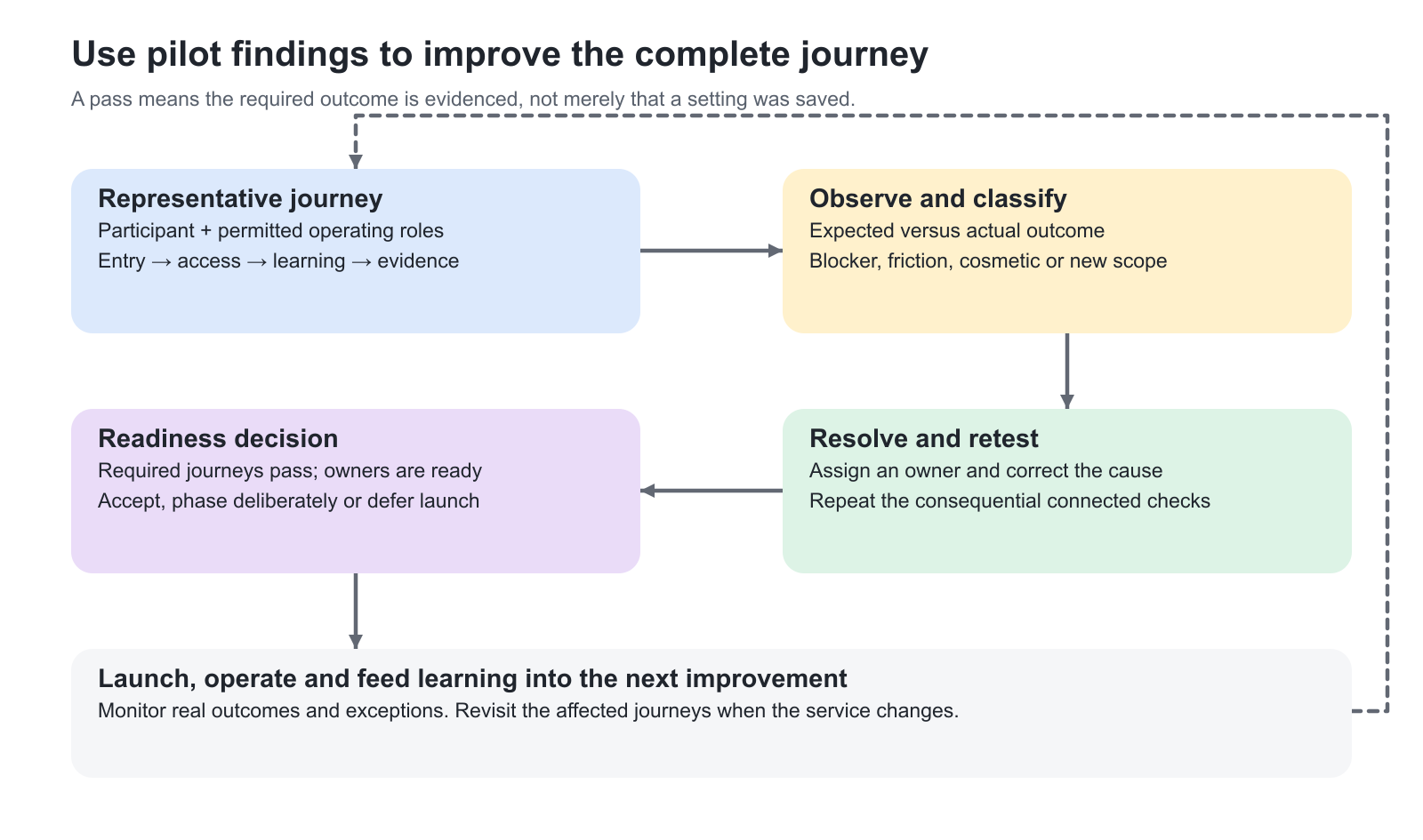
Use representative journeys, clear acceptance criteria and named issue owners. Launch when the required service works and the operating team can support it, with deliberate handling of any remaining limitations.
Use this article to:
- Choose representative pilot participants and operating roles
- Test complete journeys and meaningful access boundaries
- Distinguish a configuration check from evidence of the final outcome
- Triage issues and make a defensible go-live decision
- Prepare launch communication, support and early monitoring
Define what the pilot must prove
Return to the first-launch brief. Name the audience, entry route, learning offer, commercial conditions, intended evidence and operating team. The pilot should exercise that service rather than an easier substitute. A free administrator enrollment does not prove a business buyer’s purchase, and an author preview does not prove a participant’s restricted access.
Write acceptance scenarios in ordinary language. For example: “An invited partner technician signs in with the intended account, receives the correct foundation training, completes the required learning and can find the resulting certificate. The partner coordinator can see the permitted follow-up evidence without seeing another partner’s people.” This scenario connects the settings to the outcome.
Agree which failures block launch and who can accept a remaining issue. Use the consequence to decide severity: incorrect data exposure, an unusable paid journey or an unowned assessment process is more consequential than a minor cosmetic inconsistency.
Choose a representative pilot group
Include people with the experience, language, devices and relationships the first service must support. A small useful pilot is better than a large group of platform experts who already know how to work around every issue. Give participants realistic tasks and let them attempt the journey before explaining the expected clicks.
| Perspective | Why it matters |
|---|---|
| New participant | Reveals account entry, first-use orientation and unclear instructions |
| Returning participant | Reveals existing account, progress, participation and credential assumptions |
| A person outside the intended audience | Tests the access and relevance boundary, including direct links where applicable |
| Customer or partner coordinator | Tests delegated people management, assignment or business purchasing |
| Instructor or assessor | Tests joining, attendance, submissions, feedback and the operating workload |
| Administrator and support owner | Tests investigation, exception handling, reporting and maintenance |
| Buyer or subscription owner | Tests the commercial and beneficiary journey where it is part of the launch |
One person can exercise several perspectives where the test design allows it, but do not assume a broad administrator role represents a narrower role’s scope. Use the actual supported sign-in and account journey for checks that depend on first login or profile-triggered behavior.
Prepare safe, realistic pilot data
Use coherent names, activity descriptions, dates, prices and example requirements. Test a real decision or task rather than filler content that makes it impossible to judge whether the experience is understandable. Keep sample data clearly identified in your internal pilot record.
Use an approved environment and test process for the intended actions. Coordinate payment-provider testing, permitted recipients and any production verification with the relevant owners. A QA environment with email delivery disabled cannot prove a production mailbox receives the message. Likewise, a test payment or simulation should not be described as actual settlement.
Avoid changing live customer records merely to create a convenient scenario. Where a pilot requires real participants, data or financial processes, agree the scope and handling with the responsible people. Keep credentials and unnecessary personal information out of ordinary issue notes and screenshots.
Test the complete journey, including the operating response
Use the following matrix as a working starting point. Include the rows relevant to your launch and add the specific audience or commercial variations that change the expected result. Record the exact activity, account, role, time and evidence needed to investigate a failure.
| Journey or scenario | Expected outcome | Evidence to retain |
|---|---|---|
| Anonymous discovery, where used | The visitor understands the offer and sees only the intended public scope | Entry URL, visible offer and the supported account or enrollment step |
| Sign-in and account matching | The correct person record is used, including an existing account | Identity mapping and the resulting profile and relationships |
| Audience and organization scope | People discover and access the intended offers; operating roles act within scope | Representative included and excluded accounts, including relevant direct links |
| Assignment or self-enrollment | The intended participation is created through the actual route | Activity signup status and the participant-facing next action |
| Paid or business purchasing | The correct buyer, beneficiary, price and payment state lead to the intended result | Order or provider reference, transaction and participant record as applicable |
| Subscription or contracted access | Owner acceptance, seats, learning enrollment and period boundaries work | Owner and beneficiary views, configured dates and resulting entitlement |
| Self-paced learning | Navigation, media, practice, resume and accessibility support the task | Learner observations and the appropriate progress evidence |
| Facilitated learning | Joining, attendance, submission and assessment can be operated | Provider or manual evidence and the responsible role’s working view |
| Completion and credentials | The expected evidence produces the intended completion and certificate result | The selected activity or attempt and its relevant criteria and outcome |
| Communication and support | Messages explain the next action and the correct owner can resolve an issue | Approved recipient evidence and an actual support investigation |
| Reporting and handoff | Permitted roles can interpret the result and maintain the service | Report scope, filters, export where useful and accepted operational ownership |
Do not treat every check as a separate technical script. Group them into meaningful journeys and retain the decisive evidence. The aim is to know why the service works and where it fails, not to generate a large number of screenshots with no interpretation.
Test the negative and changed circumstances
Include the exceptions that matter to your business model. A learner may be outside the audience, already registered, missing a required profile attribute, overdue, unable to join a session or awaiting an instructor decision. A payment may be pending or cancelled. A seat may be removed or a renewal period may end.
Choose the expected response before running the case. Should the person see a useful restriction, a waiting-list route, a clear pending state or a support instruction? Confirm which role can resolve the issue and what evidence they need. A confusing but technically correct restriction can still prevent the audience from using the service effectively.
When a test reveals a policy decision rather than a defect, record it as a decision for the appropriate owner. Do not change a security, commercial or evidence rule merely to make the test pass.
Separate what each check proves
Saving a setting proves persistence. It does not by itself prove that a background process ran, a participant received access, an email reached a mailbox or an external system accepted the outcome. Verify the relevant downstream result and account for supported processing delays.
An administrator preview is useful for layout and configuration, but it may expose content and actions a learner cannot use. A successful package launch proves less than a completed assessment with correct reporting. A transaction record proves a different part of the process from confirmed external settlement. Keep these distinctions in the pilot record so a passed check is not interpreted too broadly.
Use the relevant canonical article when investigating the evidence: Understand Progress During Training for learning progress, Attendance Marking and Verification for attendance, Certificates for certificate criteria and Organization Visibility and Audience Targeting for transactions. Introduction and Basic Configuration helps the team choose and interpret the reporting perspective.
Triage findings and improve the pattern
| Finding | Recommended handling |
|---|---|
| Access, data, payment or required evidence is wrong | Treat as a potential launch blocker; establish the cause and retest the affected journey before release |
| A common task is confusing or inefficient | Improve the wording, sequence or configuration and verify with someone who encountered the difficulty |
| An optional feature is incomplete | Decide whether to defer it, remove it from the first-launch promise or complete it before release |
| A cosmetic issue does not prevent use | Assign an owner and correction date, and confirm that accessibility or meaning is not affected |
| A new requirement emerges | Assess its business value and effect on scope, dependencies and testing before adding it to the launch |
For each issue, record the symptom, expected outcome, actual outcome, evidence, owner and retest result. Look for repeated causes: one unclear audience field or a shared template may explain several failures. Correct the underlying pattern rather than adding a different workaround for every tester.
Retest proportionally after a correction. A shared identity, visibility, payment or completion change can affect several journeys and deserves a connected regression check. A local spelling correction normally needs a focused readback rather than repeating the complete pilot.
Make the go-live decision from readiness evidence
The accountable service owner should review the pilot with the owners of content, access, delivery, commercial processes, integrations and support as relevant. Confirm that the required journeys pass, critical issues are resolved and the team accepts responsibility for operation.
Record the decision, date, accepted limitations and the conditions of any phased release. If the service is not ready, state what must change and who will provide the evidence. “Not yet” can be a useful decision when it protects a required access boundary or a paid customer journey.
A staged launch can reduce operational pressure, but it should not hide a known blocker. Choose the initial audience and volume so the team can support the service and learn from real use without making promises it cannot yet fulfill.
Prepare the launch and early operating period
Give the audience a clear starting point, the reason to use the service, the action required and the support route. Coordinate invitations, standard messages, promotional activity and any required internal or customer communication so they tell the same story.
Before release, confirm who watches new registrations, unresolved payments, unassessed work, attendance exceptions and support questions. Agree an early review cadence that fits the launch volume. Keep the implementation decision record, content sources, configuration owners and integration contacts accessible to the people running the service.
Use Operate the Service and Plan the Next Stage to turn early evidence into a prioritized improvement plan. The first review should ask whether the audience achieved the intended result, not only whether the platform remained available.
Troubleshooting
| Problem | What to check |
|---|---|
| The pilot passes for administrators but fails for learners | Repeat the actual participant role, sign-in, profile and entry route; do not infer permissions from the broad administrator view |
| Settings look correct but the outcome has not happened | Check the saved state, trigger, processing, recipient or external confirmation that actually produces the result |
| The issue list grows without decisions | Assign severity, an accountable owner and a scope decision; separate defects from new requirements |
| A correction fixes one group but breaks another | Review the shared configuration and affected audience variants before applying another local workaround |
| Launch is technically ready but no one owns exceptions | Complete the support and operational handoff before increasing the audience |
FAQ
-
How many people should be in the pilot?
Choose enough people to represent the important roles, audiences, languages, devices and commercial or delivery variations. The coverage matters more than a universal number. A small group of representative users can reveal more than a larger group of platform experts.
-
Can an administrator preview replace participant testing?
No. Preview is useful for content and configuration checks, but it does not establish the learner’s sign-in, permissions, enrollment, purchasing or first-use experience. Test the relevant journey through representative accounts and roles.
-
Does a saved setting prove that emails, access or integrations work?
It proves that the configuration was saved. Verify the downstream result separately: the actual trigger, background processing, participant record, permitted recipient or external confirmation as applicable.
-
Should every open pilot issue prevent launch?
Classify issues by consequence. Access, data, payment and required evidence failures may block launch, while an accepted cosmetic issue may have a planned correction. Record who accepts the limitation and why; a phased release should not conceal an unresolved critical problem.