Launch Member Learning and Subscription Services - Article
Summary
Membership, customer agreements and Subscriptions can all support continuing learning relationships, but they are different mechanisms. Begin by deciding who is eligible, who owns the agreement and how learning access should continue or end.
Use a platform Subscription when its content, seat and lifecycle model fits the service. Keep external membership or invoicing processes clear, and coordinate entitlement, enrollment, renewal and communication so both owners and learners understand the arrangement.
Use this article to:
- Distinguish organizational membership from a platform Subscription
- Choose an appropriate ongoing-access and funding model
- Separate agreement ownership, seat assignment and activity enrollment
- Plan renewal, cancellation and commercial communication as a lifecycle
- Pilot ongoing access and reporting before scaling the service
Start with the relationship you want to sustain
An association may include learning in an external membership agreement. A manufacturer may provide a library to contracted customers. A training provider may sell recurring individual access or a team arrangement. The commercial relationship is the starting point; the platform mechanism should support it rather than redefine it accidentally.
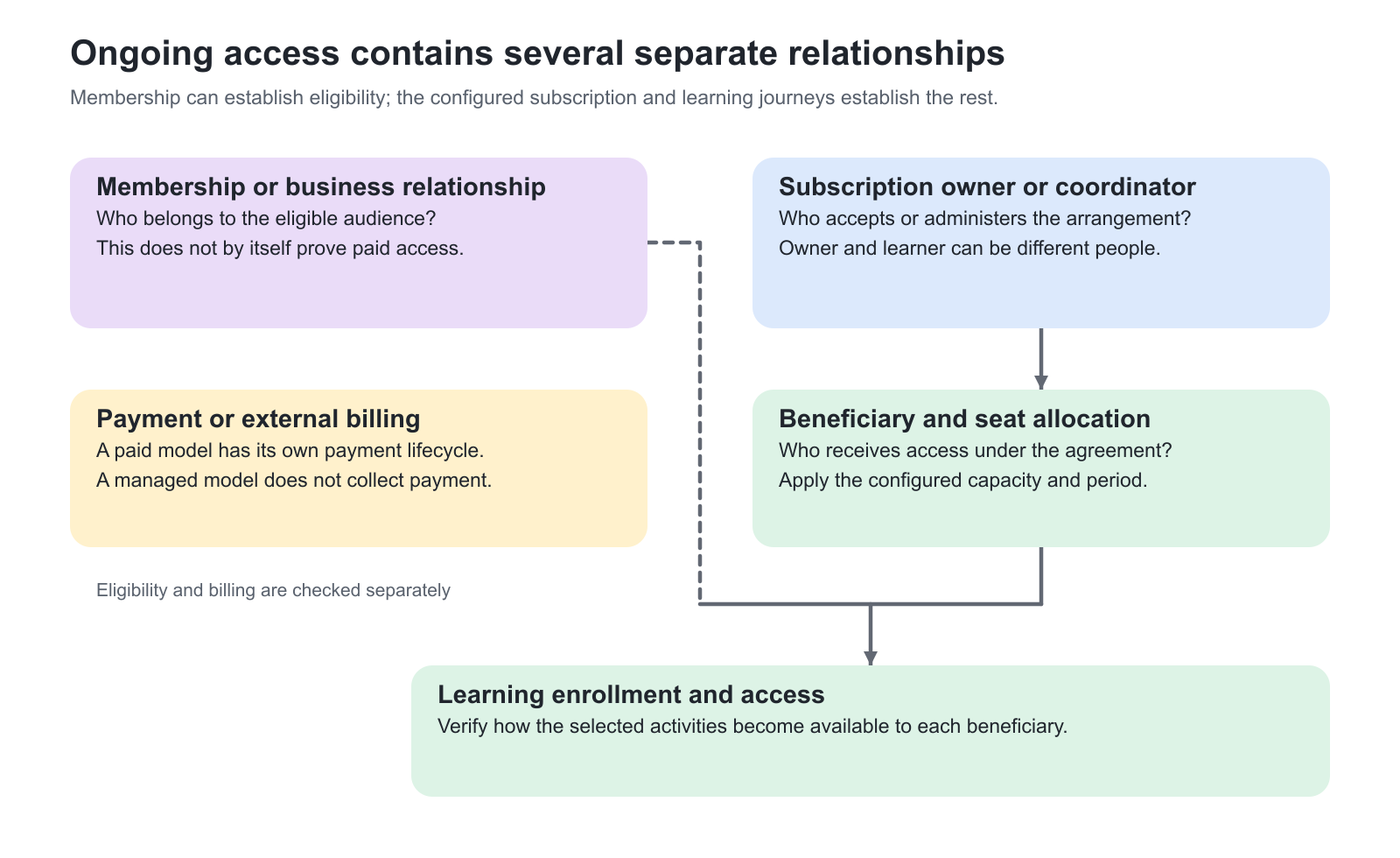
Ask who qualifies, who pays or funds access, who manages beneficiaries and how eligibility is maintained. A person being a member of an Organization does not by itself mean they hold a platform Subscription. Likewise, a Subscription owner may manage access for other people rather than complete all the learning personally.
| Service model | Possible approach | Boundary to keep clear |
|---|---|---|
| Learning included in an external membership | Use the appropriate maintained audience and enrollment model; introduce a Subscription only where its lifecycle is useful | External membership status and platform entitlement need an agreed synchronization or operating process |
| Individual recurring learning service | Use an appropriate Personal Subscription and configured recurring payment route | A subscriber’s ongoing entitlement is separate from completion of each included activity |
| Customer-owned team access | Use an appropriate Team arrangement with ownership and seat management | The owner, seat holder and participant can be different people or relationships |
| Contracted learning library invoiced externally | Consider a Managed Subscription with an agreed owner, content and period | The platform records the arrangement; it does not collect the external payment |
| One-off program or cohort | Use an activity or program purchase when ongoing access is not the intended model | Do not add recurring subscription complexity solely to deliver a single fixed offering |
Use Introduction to Subscriptions for the Subscription model, Setting up a Subscription for configuration and Managed Subscriptions for Managed arrangements. Choose the supported type and process according to the agreement you need to operate.
Define the content promise before the billing details
Explain what is included and what remains separately available. A carefully curated library can be more valuable than an ambiguous promise of “all training.” Decide whether the Subscription should use a specific collection or the applicable configured self-enrollment selection, then verify its interaction with discovery and audience rules.
Maintain coherent titles, categories and descriptions so subscribers can find useful learning. If advanced certification, instructor-led events or optional products are separately priced, make that boundary clear. A recommendation should not imply an offer is included merely because it is relevant.
Decide who approves changes to included content. Adding a useful new item may strengthen the service, while removing a central activity can alter the customer’s expectation. Treat the content promise as an operating commitment with an owner and a communication process, not just a technical selection.
Separate ownership, seats and learning participation
The Subscription owner manages the agreement through the supported owner experience. A seat assignment provides the relevant person with entitlement under that arrangement. Enrollment connects that person to a specific Training Activity, where learning and evidence are recorded. These stages must not be collapsed into one assumed action.
Some configurations support automatic enrollment in specified content after purchase; other arrangements allow the beneficiary to choose included activities. Select the approach that matches the service. Automatic enrollment can be useful for a defined starting pathway, while a broad library may be better used through clear discovery and choice.
For team access, agree who assigns seats, when reassignment is appropriate and how the owner follows progress. Verify the actual account and invitation route for a beneficiary who is new to the platform. The owner’s successful acceptance or purchase does not prove every learner has the intended seat and activity registration.
Use Use Cases and Management Overview for seat and ownership management. Where subscriber reporting is used, Participant Change History Report, Learning Performance Analytics and Progress explain the different reporting perspectives and evidence.
Plan the lifecycle as separate decisions
Before configuring reminders, decide what should happen at each transition. Continued entitlement, payment renewal, activity access and a certificate’s validity are separate outcomes.
| Transition | Decision to establish | Evidence to inspect |
|---|---|---|
| Invitation or purchase | How the owner accepts or buys the arrangement and which account is used | The intended owner and active agreement, rather than only a sent invitation |
| Seat assignment | Who may allocate access and which person receives it | The current beneficiary and their usable owner or learner route |
| Learning selection | Whether the person is automatically enrolled or chooses included activities | The expected activity participation and accessible learning |
| Renewal | Whether the arrangement continues automatically or requires an explicit extension | The configured period, next date, payment or external process and responsible owner |
| Deactivation or cancellation | When entitlement ends and which action remains reversible before the deadline | The actual state, displayed end date and resulting learner access |
| Seat removal or transfer | Whether the individual’s access ends immediately and what changes for their learning | The affected person’s current entitlement and retained completion or credential evidence |
| Content or price change | Who approves the change and how existing subscribers are affected | The applicable next-period or content behavior and required customer communication |
For illustration, a monthly period may run from 1 March to 1 April. Scheduling deactivation on 15 March can leave access available until the stated period end, with the supported reactivation options before that deadline. Removing or transferring an individual seat can have an immediate effect instead. Use the actual saved state and date; these actions are not interchangeable.
Earned certificates from completed subscription learning can remain part of the learner’s evidence after subscription access changes. Do not describe loss of entitlement as erasing every prior credential. Conversely, do not assume that an old completion record provides continuing access to all content under a new agreement.
Choose automatic payment or external settlement deliberately
For a paid recurring Subscription, confirm the configured payment-provider support, merchant responsibilities and the owner’s purchasing journey. Review failure and cancellation handling with the commercial and technical owners. Do not assume a payment method suitable for a one-time activity purchase necessarily supports the recurring arrangement you want.
A Managed Subscription is useful when the agreement is administered and billed outside the platform. Its price and transaction information support documentation and reporting; creating or renewing it does not charge a card or settle an external invoice.
Managed automatic renewal continues the configured period without collecting payment in Eurekos. With automatic renewal off, reminders support the responsible people in making the required extension decision; a reminder does not renew the arrangement by itself. Agree who checks the external contract and payment position before continuing access.
Sequence the setup and pilot
- Define the eligibility, owner, beneficiaries, content promise and commercial agreement
- Prepare the included Training Activities and their descriptions, prerequisites and evidence design
- Create the appropriate Subscription definition and content selection, billing periods and available currencies or prices
- Complete the configured recurring-payment setup or the Managed agreement process, with the relevant finance owner
- Prepare owner and beneficiary instructions, acceptance or purchasing, seat allocation and learning enrollment
- Configure coordinated communication for the applicable lifecycle, using the standard email and workflow owners
- Pilot a new owner, a beneficiary and an access-ending or renewal scenario; inspect the resulting records before scaling
Use Purchase Flow for the purchase journey and System Email Notification Overview for standard communication. Keep the detailed message inventory in its canonical owner; this implementation plan should explain the purpose, recipient and required action without creating another list of template names.
Work through a contracted-customer example
A service supplier agrees annual access to an approved product-learning library for a customer’s technicians. The contract and invoicing remain in the supplier’s business systems. A Managed Subscription can represent the agreed learning access, with a named customer owner allocating the permitted seats.
The implementation team first prepares the library and customer relationship, then proves the owner’s acceptance and a technician’s seat and enrollment journey. Finance owns the external agreement; the academy owner owns the included content and access period. Before renewal, the responsible people confirm the commercial decision and perform the applicable extension or automatic-renewal process.
The model can later grow to include more products or separately priced advanced training. Keep the original content promise and agreement boundaries understandable, and test the effect of a live change before using it for all customers.
Verify the ongoing service
| Scenario or check | Expected result or evidence |
|---|---|
| Owner and beneficiary | The correct people receive the intended ownership, seats and learning relationships |
| Included and separate offers | The subscriber can distinguish included learning from additional purchasing |
| Renewal and period end | Dates, messages, access and the required responsible action match the agreement |
| External billing | Finance can reconcile the documented arrangement without mistaking it for collected payment |
| Seat or content change | The affected learner’s access and retained evidence match the supported lifecycle |
| Reporting | Authorized owners can interpret current entitlement and learning progress without confusing people, seats and enrollments |
Troubleshooting
| Problem | What to check |
|---|---|
| A member expects subscription access but has none | Check the external membership relationship, the actual Subscription and beneficiary entitlement separately |
| The owner accepted but a learner cannot start | Inspect seat assignment, activity enrollment, content selection and the learner’s actual route |
| A renewal reminder was sent but access ended | Confirm whether an explicit extension was required and which owner was responsible; the message itself is not renewal |
| Finance expects a charge from a Managed arrangement | Review the external billing process; Managed Subscription values are recorded without collecting payment |
| A transferred seat creates unexpected access or history questions | Inspect the specific lifecycle action and retained evidence before assuming the new beneficiary inherits the previous person’s learning |
FAQ
-
Does organization membership mean the person has a Subscription?
No. Organizational membership, Subscription ownership or seat entitlement and activity enrollment are separate relationships. Decide which mechanism supports your membership agreement and how eligibility is maintained.
-
Does renewing a Managed Subscription collect payment?
No. A Managed arrangement documents access and financial information while billing and settlement are handled externally. Automatic renewal continues the configured period; finance and contract owners must still operate their external process.
-
Does assigning a seat always enroll the person in every included activity?
Do not assume so. Enrollment depends on the Subscription content model and supported automatic-enrollment configuration. Verify whether beneficiaries choose activities or are enrolled through the intended configured route.
-
Does cancellation erase certificates already earned through a Subscription?
Earned certificates from completed subscription learning remain available as learning evidence under the supported lifecycle. Loss of subscription entitlement and retained credential history are different outcomes. Inspect the affected person and activity when investigating a specific case.