Introduction to Course Administration - Article
Introduction to Course Administration
Course Administration is where you turn learning content into a learning experience that can be delivered to people. At the center is the Training Activity: a flexible structure for combining learning, people, schedules, access, communication, certification and business processes into the journey you want to provide.
In this article you will learn:
- What Course Administration is designed to achieve
- Why the Training Activity is at the center of learning delivery
- How courses, events, assignments and other activities can form a learning journey
- How enrollment, automation, approvals, certification and commerce connect to training
- How the same structure can support anything from a single course to complex training programs
From content to learning delivery
Creating learning content and delivering learning are two different things. Content Authoring is where you create what people learn. Course Administration is where you decide how that learning should happen.
Imagine that you have created an online course. The content may already be complete, but there are still many questions before it becomes an actual training offering:
Who should take it? Can people enroll themselves? Is it mandatory? Should someone approve their participation? Does it need to be completed before a particular date? Is there a classroom or virtual session involved? Should learners receive reminders? What happens when they finish? Do they receive a certificate? Do they need to renew it later? Is the training free, sold individually or included as part of a subscription?
Course Administration connects those decisions.
For the simplest use case, the answer may simply be to make the course available and let people start learning.
For another organization, the answer could involve a two-month certification program with online courses, classroom sessions, practical assignments, participant applications, instructors, automated communication, multiple available dates and recurring certification.
Both can be built from the same underlying concept.
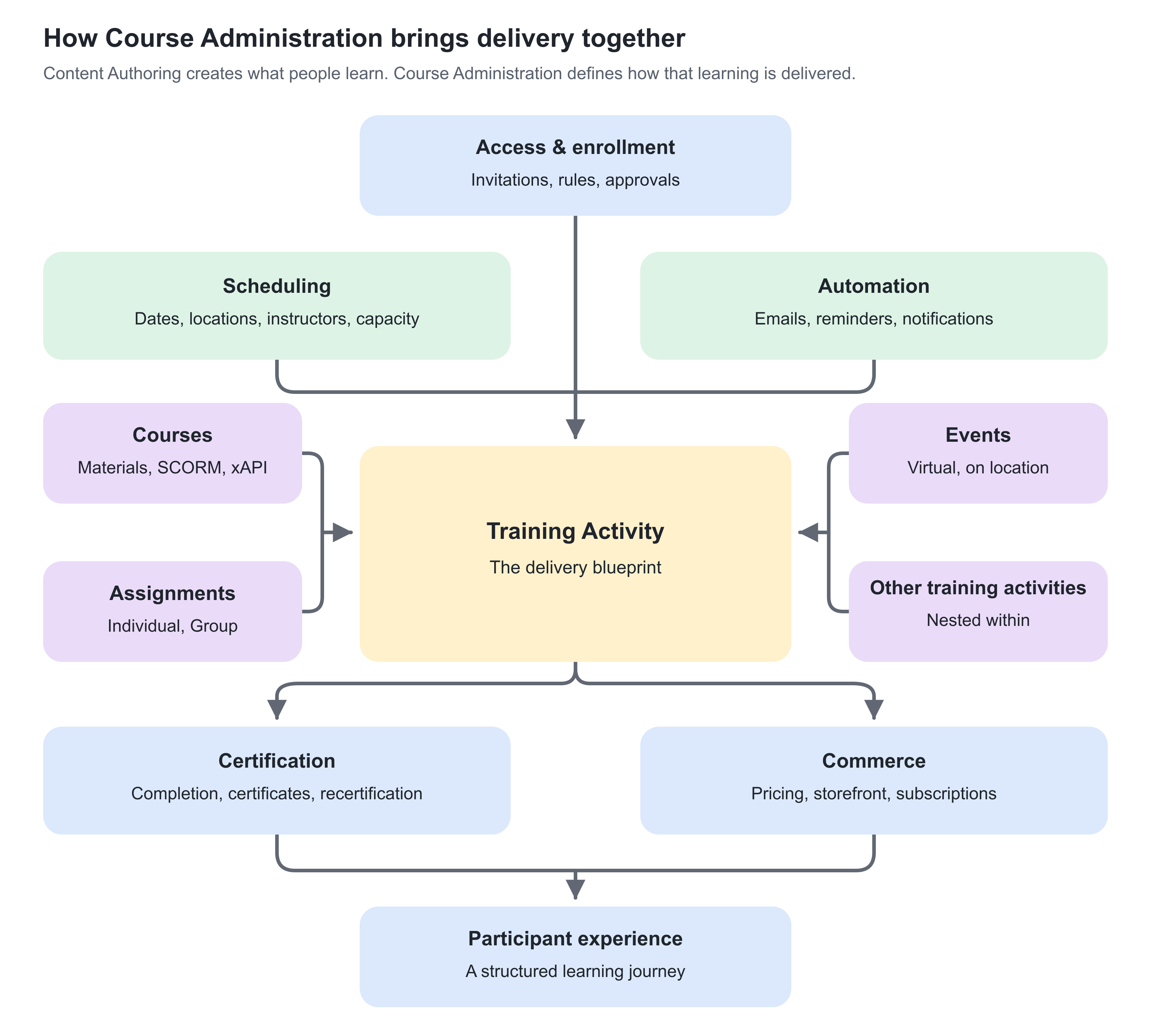
The Training Activity is the center of the experience
The central building block in Course Administration is the Training Activity. A useful way to think about a Training Activity is as the blueprint for how learning will be delivered.
It does not prescribe a particular educational model. Depending on your organization or industry, what you create might be called a:
- Course offering
- Learning path or learning journey
- Training program or certification program
- Curriculum
- Workshop or webinar
In Eurekos, these can all be represented through a Training Activity. A Training Activity can be as simple as one self-paced course. It can also bring together multiple courses, events, assignments and even other Training Activities to create much larger structures.
This makes the Training Activity more than a container for content. It is where you define what participants should experience and connect the processes required to make that experience work.
Start with the journey, not the settings
When creating a Training Activity, it is often easier to begin with one question: What should happen for the participant?
For example:
- A participant might enroll in an online course and begin immediately.
- Another might first complete an application, receive approval and then select one of several available classroom dates.
- A certification journey might require learners to complete online preparation, attend an instructor-led event, submit an assignment and successfully complete the required learning before a certificate is issued.
- A customer academy might allow participants to discover and purchase individual training activities, while subscribers receive access to a broader collection of learning.
- A compliance program might automatically enroll the relevant people, communicate deadlines, monitor completion and initiate re-certification when their qualification approaches expiry.
Once you know the journey, Course Administration provides the building blocks for making it happen.
Bring the learning together
Training Activities allow different forms of learning and facilitation to become part of one coherent experience.
You can combine courses for self-paced learning, events for virtual or face-to-face training, assignments for practical work or instructor evaluation, and existing Training Activities when a larger program should contain other learning journeys.
Each part can have its own purpose, timing and rules while still belonging to the same overall experience.
This is particularly useful for blended and hybrid learning, but it is just as useful when the requirement is simple. You do not need to use complexity simply because it is available.
Connect the processes around the learning
Real-world training usually involves more than delivering content. Course Administration connects the learning journey with the operational processes around it.
| Access and participation | Decide how people enter the journey. Participants can be enrolled administratively, enroll themselves, receive invitations, be assigned automatically based on defined rules or enter through connected systems and integrations. Where additional control is needed, enrollment can become part of a larger process involving applications, questionnaires, approvals, seat restrictions or waiting lists. |
| Schedules and facilitation | Learning can happen at any time or at a particular time and place. Training Activities can connect schedules, recurring delivery dates, instructors, virtual meetings and physical locations. This makes it possible to coordinate self-paced, virtual, classroom and hybrid learning within the same overall structure. |
| Communication and automation | Many repetitive administrative tasks can become part of the journey itself. Automated workflows can communicate with participants and other stakeholders around dates, registrations, completion, deadlines and other events. Instead of manually remembering every message that needs to be sent, communication can follow the rules of the training. |
| Completion, achievement and certification | Different learning experiences have different definitions of success. A simple course may be complete when the required content has been viewed. Other programs may depend on attendance, assignments, questionnaires, instructor decisions or several learning components. Certificates and re-certification can then connect achievement with formal recognition, qualification or recurring compliance requirements. |
| Discovery and commercial delivery | A Training Activity can also become something people discover and choose. It can be presented through the Storefront, targeted toward particular audiences and made available for self-enrollment. Training can be free, priced individually or made available through broader commercial models such as subscriptions. |
This allows the same learning-delivery structure to support internal training, customer education, partner enablement, professional training and commercial academies.
Build the model that fits your organization
There is no single correct way to design a Training Activity.
- A manufacturer training technicians may structure learning around product certification and recurring qualifications.
- A professional training provider may think in terms of curricula, scheduled cohorts and instructor-led programs.
- A software company may create customer onboarding journeys combining self-paced learning, webinars and continuing product education.
- An association might provide membership learning through subscriptions and certification programs.
- An internal academy may automatically assign mandatory learning according to organizational role or profile.
The terminology and business purpose may be different, but the underlying challenge is the same: connecting the right learning with the right people, at the right time, through the right process.
Course Administration is designed to provide that flexibility without forcing every training scenario into the same model.
Simple when it should be. Powerful when it needs to be.
Not every Training Activity needs schedules, workflows, approvals, certificates or commerce. If your requirement is simply to make one course available to a group of people, that may be all you configure.
As your learning model develops, the same Training Activity can become part of something larger. Courses can be reused in different learning journeys, scheduled training can be repeated for new cohorts, activities can be combined into larger programs, and additional processes can be introduced where they provide value.
This allows you to start with the learning experience you need today without designing yourself into a corner.
Think about the outcome first
The easiest way to understand Course Administration is therefore not to begin with its individual features. Begin with the desired outcome.
What should people learn? Who should participate? How should they move through the experience? What needs to happen around them? And what should happen when they succeed?
The Training Activity gives you the structure to turn those answers into a working learning experience.
The purpose of Course Administration is to transform learning content into learning journeys that can be delivered, managed, and scaled around the way your organization actually works.
To put this model into practice, start with Creating a Training Activity. Use Activity list to manage deliveries and Enroll and register participants to choose and operate the enrollment route.
FAQ
-
What is a Training Activity in Eurekos?
A Training Activity is the structure used to organize and deliver learning. It can contain a single course or combine courses, events, assignments, and other Training Activities into a larger learning journey or program.
-
Do I need a Training Activity for every course?
Yes, but not necessarily as a complex setup. A Training Activity can be very simple and may exist only to make a course available to participants. Additional settings are only needed when the learning experience requires them.
-
Can one course be used in several Training Activities?
Yes. The same course can be reused in different Training Activities, allowing you to create different learning journeys, audiences, schedules, or commercial offerings without recreating the learning content.
-
Can I combine online and instructor-led learning?
Yes. Training Activities can combine self-paced courses with virtual or classroom events, assignments, and other learning components to support blended and hybrid learning.
-
How do participants get access to a Training Activity?
Access can be provided in several ways depending on your setup, including administrator enrollment, self-enrollment, invitations, automated assignment, applications and approvals, Storefront registration, subscriptions, or integrations.
-
Can a Training Activity include certificates and re-certification?
Yes. Training Activities can be connected with certificates and recurring re-certification requirements, allowing learning completion to support formal qualifications, compliance, or continuing education.
-
Can Training Activities be used for paid training?
Yes. Training Activities can support commercial delivery through the Storefront, including pricing and other commerce-related options. They can also form part of broader subscription-based learning offerings.
-
Should I configure every available Course Administration option?
No. Start with the experience you want to provide and configure only the capabilities that support it. A simple learning activity may require very little configuration, while more advanced programs can add schedules, automation, approvals, certification, commerce, and other processes as needed.