Operate the Service and Plan the Next Stage - Article
Summary
A successful launch creates a usable service. Ongoing operation makes that service dependable, relevant and valuable as people, content and business priorities change. Growth can mean a better experience for the current audience before it means more features, languages or markets.
Use operational evidence to recognize your present stage, choose the next useful outcome and build only the capabilities your team can maintain. An established academy can enter this cycle with existing strengths rather than starting again.
Use this article to:
- Establish practical ownership and a proportionate operating cadence
- Recognize your current stage and select a realistic next step
- Interpret learning, service and business evidence together
- Maintain content, access, communication and integration dependencies
- Turn successful patterns into a repeatable improvement plan
Move from a launch project to a service people can rely on
Make the operating handoff explicit. The people who created the platform configuration may not be the people who answer participant questions, assess assignments, maintain product guidance or reconcile purchases. Give each recurring responsibility a named owner, a backup where needed and a clear route for exceptions.
Keep the first-launch brief and pilot findings as a starting point. What result did you promise, for which audience and through which journey? Review whether that result is happening. A technically available platform is only one part of a service that people can understand, trust and use.
For example, a manufacturer may have launched partner installation training. The next useful improvement might be faster assessment and clearer access to the relevant manual, rather than a second catalog brand. A training provider with reliable enrollment but frequent payment questions may need clearer purchase communication before adding a subscription offer.
Recognize where you are now
The stages below are practical reference points, not a required certification or a competition between organizations. You may be advanced in content design and still be piloting a new customer audience. Use the model for the service or audience you are improving, rather than assigning one score to the entire organization.
| Your current situation | A sensible next outcome | Typical first steps |
|---|---|---|
| Establish: people still depend on manual coordination | Make one important journey dependable | Choose one audience and offer; resolve account, enrollment, content and support gaps; repeat the pilot with actual users |
| Repeat: the first service works, but every new offer takes too much reinvention | Create a maintainable operating pattern | Agree reusable Course patterns, activity checks, responsibilities, communication and evidence; document the exceptions |
| Extend: the pattern is reliable and another audience or business model has a clear need | Add a controlled variation | Identify what changes in identity, access, language, delivery or commercial terms; reuse the proven foundation and pilot the difference |
| Optimize: several services work and meaningful evidence is available | Improve value and efficiency deliberately | Investigate friction, compare appropriate cohorts, remove unnecessary work and test one improvement against a stated outcome |
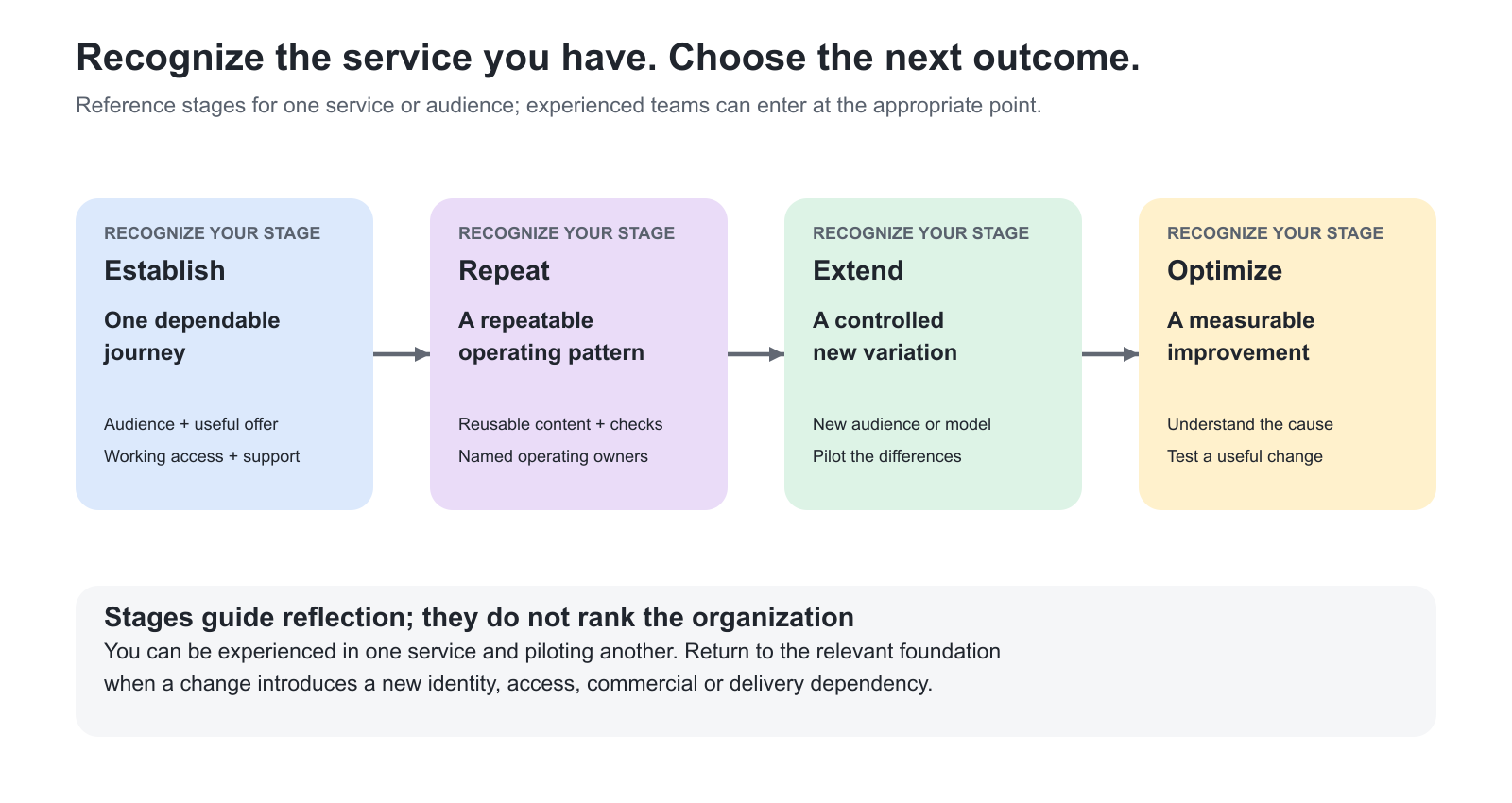
An experienced team can begin at Repeat or Extend where the foundation is already sound. A first-time team may make rapid progress with a narrow offer. Conversely, expanding an unreliable process can multiply its problems. Base the next step on demonstrated readiness and available people, not the number of options enabled.
Use a small operating scorecard
Choose a few indicators that answer the questions your service owner actually needs to ask. Define the audience, period, activity and meaning of each indicator. A total without the right denominator or scope can disguise the problem you are trying to solve.
| Question | Useful evidence | How to interpret it |
|---|---|---|
| Can the intended audience get started? | Registration, assignment or enrollment results; entry and support questions | Separate people who could not enter from people who chose not to enroll |
| Do participants make useful progress? | Relevant progress, assessment and completion evidence | Check the learning design, available time and delivery conditions before assuming low motivation |
| Are credentials and renewal obligations working? | Certificate criteria, issuance, expiration and the relevant participation records | Distinguish a valid credential, access period, deadline and a new attempt |
| Does the service support the business purpose? | Appropriate purchase, subscription, participation or operational outcome evidence | An order, an enrollment and a settled payment are different events; use the correct record for the question |
| Is the experience understandable and useful? | Support themes, page feedback, questionnaires and NPS where relevant | Sentiment identifies a signal to investigate; it does not establish the cause by itself |
| Can the team maintain the offer? | Content review backlog, assessment queues, integration exceptions and owner availability | Prioritize a bottleneck that repeatedly prevents the intended outcome |
Use Introduction and Basic Configuration to choose the appropriate reporting perspective. Adaptive Learning Fingerprint Analytics and Reports supports a more detailed view of adaptive learning patterns where used. Newsletter Consent Status Report addresses newsletter consent status; it is not a substitute for a broader legal or communication policy. Choose reports because they answer a real question, not simply because data is available.
Compare like with like. A facilitated activity that has not reached its assessment date is different from an overdue self-paced obligation. A new partner group is different from experienced technicians renewing an established credential. Record the explanation and investigate a change before claiming that one configuration caused it.
Keep the review cadence proportionate
| When | Focus | Expected decision or action |
|---|---|---|
| During an active launch or busy delivery period | Entry issues, payment exceptions, upcoming sessions, assessment queues and urgent support | Resolve a current blocker and assign the correct owner |
| At a regular service review | Participation, learning evidence, feedback, content changes and recurring operating effort | Choose a small number of improvements with an owner and intended outcome |
| Before a renewal, new audience or major expansion | Access periods, certificates, capacity, commercial terms and dependencies | Confirm readiness, pilot the changed journey and communicate what people need to do |
| When a policy, product or integration changes | Affected content, configuration, messages, documentation and downstream evidence | Update the connected service and retest the consequential paths |
The frequency depends on volume and risk. A weekly review may suit an active launch, while a smaller stable academy may need a lighter routine. Avoid a meeting that produces a dashboard but no decision. End with the action, owner, expected evidence and next review point.
Maintain the portfolio as a connected service
Keep a simple ownership register for your Courses and learning offers: purpose, audience, source owner, delivery owner, review trigger and important dependencies. Review on meaningful events such as a product revision, policy change or repeated learner difficulty, as well as any scheduled review date.
A Course update can affect several Training Activities that use it. Decide whether the change belongs in the existing learning experience or needs a deliberate new version or offer. Use Update Courses Safely: Revisions, Versions, and Shared Assets for the product procedure and its consequences. Do not assume that revising the content automatically makes every existing learner repeat it or creates a new credential obligation.
Keep related assets aligned. A revised procedure may require a page explanation, a video subtitle, an assessment answer and a Resource Library manual to change together. External embedded material remains dependent on its source. Test important links and participant access after the change, including language and audience variations that matter.
Reusable page templates provide a page-level starting point. A deliberately prepared source Course can provide a complete structure that authors clone and adapt. Maintain these as assets with owners and review dates; copying a strong pattern is useful only while its content and assumptions remain correct.
Choose the next practical move from a recognizable situation
| You recognize this situation | Recommended next move | Readiness check |
|---|---|---|
| People ask which training applies to them | Clarify audience, category and offer descriptions; simplify the intended entry route before adding more rows | A representative person can find and understand the relevant next action |
| The same group is assigned manually every month | Consider a verified audience-driven assignment pattern and its triggers | Profile data and exceptions are reliable; a pilot proves both included and excluded cases |
| Partners keep requesting documents after training | Consider a curated Resource Library alongside the training where enabled | Documents are approved for the audience, categorized appropriately and maintained by a named owner |
| A growing customer wants to manage its own people | Evaluate the appropriate organization, delegated role and business access model | The coordinator can complete the task within the intended people and reporting scope |
| A one-time course is becoming an ongoing service | Evaluate a subscription or contracted-access model rather than repeatedly recreating ad hoc access | Ownership, beneficiaries, access periods, renewal and the payment or external billing process are clear |
| Another region wants the same offer | Reuse the proven design while addressing language, ownership, audience and commercial differences | The localized journey has been reviewed by a suitable person and tested from entry through evidence |
| Administration consumes time that could support learners | Identify a repeated stable process before selecting automation or an integration | The data owner, trigger, exception handling and monitoring are agreed |
| The portfolio is large but engagement is weak | Investigate relevance, discovery, content usefulness and friction before building more courses | You can name the affected audience and test a specific improvement |
These moves can be combined, but sequence them around the constraint. A more sophisticated discovery experience cannot fix missing required learning, and additional automation cannot compensate for an undefined business rule. Use Storefront Maturity Model for the more detailed Storefront maturity perspective.
Make a small, evidence-led improvement plan
- Name the problem in audience and business terms: who is affected, what they cannot achieve and why it matters.
- Establish the current evidence and check the cause with the people closest to the work. Separate a content issue, an access rule, a process gap and an interface misunderstanding.
- Choose the smallest useful change and its expected result. State what will remain outside this iteration.
- Identify the dependencies and operating owner. Include content, communication, integration, financial or permission owners when their work is affected.
- Pilot the changed journey with representative people and compare the appropriate evidence. Check important boundaries and exceptions as well as the successful route.
- Adopt, adjust or stop the change. Record the result, update the reusable pattern and choose the next priority from what you learned.
For example, “reduce repeated requests for the installation manual” is specific enough to test. The change might be clearer Resource Library access and a contextual link during the course. Review whether the intended people can retrieve the correct revision and whether support requests change. Enabling an AI assistant may extend this experience where configured, but it still depends on appropriate source information, relations and permissions.
Grow at the pace the operating team can sustain
Keep a prioritized backlog with value, effort, dependencies and readiness. Revisit the first-launch plan when a new business model introduces a genuinely different journey: a paid buyer, a delegated customer administrator, another identity provider or a new credential scheme. Reuse Plan Your First Launch and Implementation Workstreams and Pilot Your Learning Service and Prepare for Go-live rather than treating growth as an untested configuration exercise.
Self-paced guidance and facilitated implementation support can complement each other. Use the team’s experience, capacity and the consequences of the decision to choose where specialist assistance adds value. Keep routine operating knowledge in a form that survives a personnel change: clear decisions, canonical instructions, realistic examples and evidence of the result.
Troubleshooting
| Problem | What to check |
|---|---|
| The team wants every available feature in the next phase | Return to the audience outcome and present constraint; select a limited set of changes the team can operate and verify |
| Reports disagree about success | Compare the population, activity, period and meaning of each measure; enrollment, progress, credentials and financial settlement answer different questions |
| Every new course repeats the same mistakes | Improve the shared Course pattern, review checklist or ownership process before copying it again |
| The service declines after the project closes | Restore named operating owners, review triggers, exception handling and a practical improvement cadence |
| An expansion works for one audience but not another | Review the changed identity, permission, language, commercial and delivery assumptions and pilot the affected journeys |
FAQ
-
Must every academy follow the same maturity stages?
No. Use the stages to recognize the service or audience you are improving. An experienced team may already have reliable patterns, while a new business model can still require a pilot. Choose the next useful outcome from evidence and capacity rather than treating the stages as a compulsory sequence.
-
Which measures should we review after launch?
Choose measures that answer your operating and business questions: whether the intended audience can enter, participate, achieve the learning outcome and receive the expected evidence, and whether the team can maintain the service. Interpret progress, credentials, sentiment and commercial records according to their actual meaning and scope.
-
Should we automate a process as soon as it becomes repetitive?
First establish the rule, data quality, ownership and exception handling. Automation is most useful for a stable process with a clear trigger and a way to verify the result. Pilot the change and keep an owner for failures or cases that require judgment.
-
How should we choose between improving the current service and adding another audience?
Compare the intended value, current friction, dependencies and operating capacity. Resolve a weakness that would be repeated by expansion, reuse proven patterns where possible and pilot the differences introduced by the new audience. Growth can first mean a more dependable service for the people already using it.