Plan Your First Launch and Implementation Workstreams - Article
Summary
A launch date becomes useful when it is connected to a defined service, available people and a realistic amount of work. Content preparation, audience data, configuration and integration often progress at the same time, but they meet at a shared participant journey.
Build an implementation plan around clear decisions, a representative working example and evidence of readiness. This lets you make progress without overbuilding, while exposing dependencies early enough to manage them.
Use this article to:
- Turn a business objective into an achievable first-launch scope
- Assign owners and sequence parallel implementation workstreams
- Estimate content and migration work using representative examples
- Manage decisions, dependencies and changes without unnecessary project overhead
- Use readiness gates and an operating handoff to support go-live
Write the launch brief before the task list
Use Quick Guide: Run an Implementation Kick-off and Build Your Checklist to lead the initial conversation and capture a tailored working checklist. This article develops the resulting scope, ownership, dependencies and readiness plan in more detail.
Start with what your organization needs to achieve. A target such as “launch the LMS in six weeks” does not say which people must succeed, what content must be ready or whether payment, identity and certification are essential. Replace it with a service statement that can be tested.
For example: “Our first launch will let authorized service partners complete a product commissioning pathway in English, submit a practical assessment and obtain a certificate. Partner coordinators will identify the audience; named instructors will review the work; our academy team will support access questions.” This exposes content, audience, facilitation and evidence work immediately.
| Brief item | Record the decision |
|---|---|
| Business outcome | The operational or commercial problem the first service should improve, and an observable sign of improvement |
| First audience | Who is included, who is excluded for now and which variations must be represented in the pilot |
| First portfolio | The specific training offers and required assets that must be ready, with an accountable content owner |
| Entry and delivery route | How people obtain an account and access, whether they choose or receive training, and which learning formats they use |
| Commercial arrangement | Whether access is free, purchased, employer- or partner-funded, membership-based or provided through a Subscription |
| Evidence and support | What proves the intended result, who follows up, and who handles participant and administrator questions |
| Launch boundary | What is required on day one, what is deferred and who can accept a change to that boundary |
Keep this brief short enough to revisit in a working meeting. Its purpose is to align decisions, not produce a large document that becomes obsolete before configuration begins. Where a policy, contract or technical design already owns a decision, reference it rather than creating a competing version.
Assign ownership of the work and the decisions
Identify one accountable service owner who can resolve competing priorities. Then name the people who do the work and approve important outcomes. One person may hold several responsibilities in a small academy; an enterprise program may distribute them across several teams.
| Responsibility | Practical ownership | Decision or deliverable |
|---|---|---|
| Service and project leadership | Academy owner or implementation lead | Scope, priorities, accepted risks, launch decision and the operating handoff |
| Learning and content | Content owner, subject specialist and designer | Learning outcomes, asset rights, usable content, review and maintenance |
| Platform configuration | Authorized administrator | Audience structure, delivery offers, settings and representative-user checks |
| Identity and integrations | Relevant internal system owners and technical specialists | Stable user matching, data responsibility, connection readiness and failure handling |
| Commercial and finance | Commercial owner and finance team | Offer, buyer journey, prices, taxes, agreements, invoicing and reconciliation responsibilities |
| Facilitation and support | Instructors, coordinators and support owner | Assessment turnaround, participant communication, exceptions and support routes |
Agree how decisions are made when a specialist is unavailable. A configuration question can often be resolved by an administrator; a decision about who may see customer data or how a contract is charged requires the appropriate owner. Avoid allowing a project meeting to silently become a substitute for that approval.
Run workstreams in parallel with shared checkpoints
Do not make the entire implementation wait for the slowest optional connection. Content development, offer design, branding and support preparation can often proceed while integrations are built. Equally, do not assume these workstreams are independent: the sign-in data may determine audience rules, and the evidence model may determine the content and assessment design.
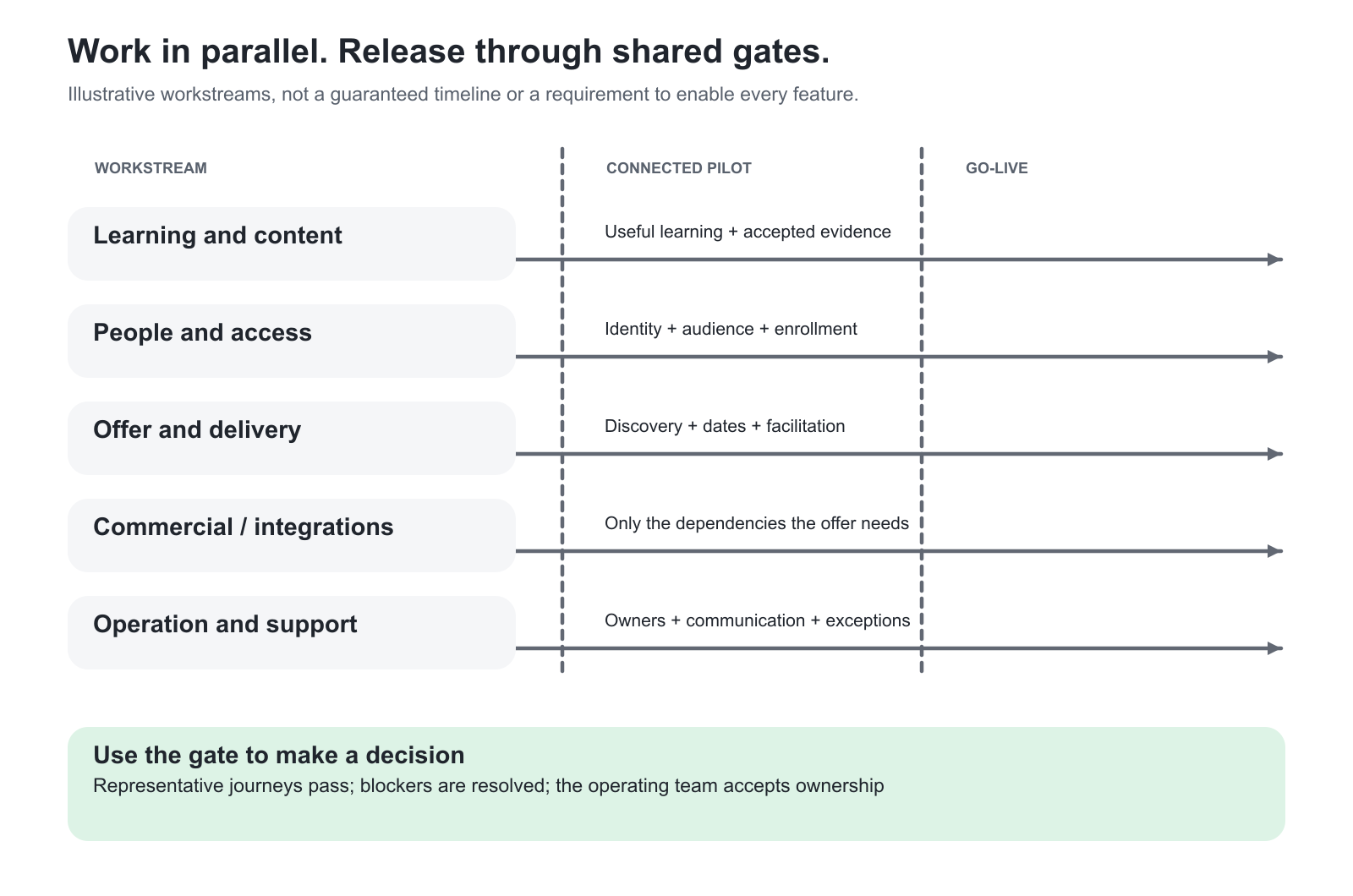
| Workstream | Start with | Ready when |
|---|---|---|
| Content and learning design | Inventory, learner tasks and a representative item | The first portfolio is reviewed, accessible, understandable and maintainable |
| People and access | Identity source, profile data and organizational relationships | Representative people receive the correct identity, scope and access |
| Delivery and discovery | One representative Training Activity and the intended entry route | The audience can find or receive the right offer and understand what happens next |
| Commercial and integration work | Required day-one processes and system owners | The required connections or approved interim processes work, including exception handling |
| Communication and operations | Participant messages, facilitation and support ownership | The team can operate normal and exceptional journeys, and required messages reach recipients |
| Pilot and readiness | Acceptance scenarios and representative testers | Decisive journeys pass with evidence and an agreed response to remaining issues |
Review progress through the shared journey rather than reporting only percentages of tasks complete. A finished content file, a working identity connection and a configured activity can still fail together if they refer to different audiences or identifiers. Demonstrating one coherent example reveals this earlier.
Measure the work before multiplying it
Choose representative samples: a short and a long imported package, a typical native lesson, a facilitated activity, or a buyer journey with the payment route you intend to use. Complete the process through review and participant verification. Record the work required, including corrections, rather than measuring only the upload or first edit.
For illustration, if your team has twelve suitable short modules and can review and verify three each week, four weeks of that review capacity are already committed. That estimate still excludes author corrections, integrations and pilot issues. If one sample takes twice as long as expected, revise the plan before promising the same date for the full portfolio. These are planning examples, not Eurekos production rates.
Track content by useful states: owner confirmed, source usable, in production, specialist review, platform verification and ready for launch. A Course being present in the library does not establish that its language, accessibility, assessments, delivery offer or support instructions are ready.
Choose a plan that fits your starting point
These patterns show how sequencing changes. They are examples of work order, not guaranteed implementation durations.
| Starting point | Typical first sequence | Watch closely |
|---|---|---|
| Ready content and a small defined audience | Confirm access and evidence → import a representative item → build the delivery offer → test the complete journey → migrate the first batch → pilot | Package behavior, identity matching and whether existing history needs a separate migration |
| Good expertise but little finished content | Agree learning outcomes → build one complete example → establish the review pattern → produce the first portfolio while configuring delivery → pilot | Specialist availability, design and review capacity, media rights and the amount of rewriting |
| Established commercial academy | Map the current offer and buyer journey → prove purchasing and financial handoff → migrate representative content and customers → pilot → controlled transition | Price and tax decisions, recurring access, existing agreements and customer communications |
| Complex integration or multi-market rollout | Prove a representative vertical slice → progress technical work in parallel → establish a supported first market or audience → expand after evidence | Non-negotiable identity/security dependencies, local ownership, languages and realistic support coverage |
Use a controlled launch if it proves the business model without exposing an unfinished service to everyone. A limited audience is useful only when it is representative: a pilot consisting entirely of platform experts will miss the questions and access problems real participants experience.
Keep a dependency and decision log
For each important dependency, record the required outcome, owner, needed-by date, affected work and fallback decision. “Waiting for IT” is not actionable. “The identity owner must confirm the stable identifier and profile attributes before we import the pilot users” is.
Classify dependencies as launch blockers, parallel work or planned later improvements. An SSO connection may be a launch blocker where corporate access policy requires it. In a different service, a controlled manual import may support a small pilot while the connection is completed. The decision depends on access, data, security, workload and contractual requirements; it is not a universal recommendation to postpone integrations.
Keep a record of decisions with the reason and the owner. This is particularly valuable for customer types, organization boundaries, identifiers, content reuse, certificate evidence and live-change policies. When the team grows, people should be able to understand why the setup exists without relying on the original implementer’s memory.
Manage changes through their consequences
When a new requirement appears, ask what it changes in the participant journey, content, dependencies, testing and operation. Decide whether it must enter the first release or belongs in a later stage. A visually small change can be substantial if it adds another purchasing route, language or audience boundary.
Keep a short prioritized backlog of deferred improvements. Record the expected benefit and the condition that would make each one worthwhile. This preserves ambition while protecting the first launch from an expanding collection of unrelated features.
Use evidence-based readiness gates
Agree the checks early, then use them to make a go/no-go decision. The full participant and operational pilot is covered in Pilot Your Learning Service and Prepare for Go-live.
| Gate | Evidence to review |
|---|---|
| Scope and foundations agreed | First audience and outcome approved; owners named; identity, access and commercial decisions recorded |
| Representative service works | One complete offer demonstrates the real entry, learning, evidence and support journey |
| First portfolio ready | Required content and delivery offers reviewed; rights, language and accessibility checks complete |
| Pilot accepted | Representative journeys pass; critical issues resolved; remaining issues have owners and accepted handling |
| Operation ready | Participant communication, support, facilitation, finance and monitoring responsibilities accepted by the people who will run them |
A late cosmetic issue may be acceptable with a planned correction. An audience receiving another customer’s material, a broken paid enrollment or an unowned assessment queue is a different class of issue. Use the consequence to decide severity, rather than the size of the visible defect.
Hand the implementation into normal operation
Before launch, identify where your team will find the maintained configuration decisions, approved templates, source content, integration owners and support procedures. Agree how live changes will be tested and how new administrators or instructors will learn their responsibilities.
Schedule an early service review after real use has produced meaningful evidence. Compare the expected audience and outcome with actual participation, completion, support questions and commercial results where relevant. Use Operate the Service and Plan the Next Stage to choose the next improvement without restarting the entire implementation.
FAQ
-
How long should we allow for implementation?
Estimate from your first-launch scope, representative content and configuration work, specialist availability, integration dependencies and pilot corrections. Use a completed sample to establish throughput before multiplying the estimate. There is no single duration that fits both a small assigned-training launch and a multi-market commercial migration.
-
Should content development wait until every integration is complete?
Usually the team can progress some content and delivery work in parallel, provided the audience, learning outcomes and required inputs are agreed. Keep non-negotiable identity, access, security and financial dependencies on the critical path, and test the combined journey before launch.
-
What should we do when the required launch date is fixed?
Make the trade-off explicit: define the service that must work, identify true blockers and reduce or phase the remaining scope. Keep a complete participant and operating journey. Removing a required access or evidence control is not the same as reducing optional scope.
-
Who should approve go-live?
Name the accountable service owner in the launch brief. That person should decide using evidence and input from the owners of content, access, commercial processes, integrations, facilitation and support. Completing a configuration task does not by itself authorize the service launch.