Adaptive Learning Report - Article
Summary
Adaptive Learning analytics shows how learners move through adaptive paths, which rules are triggered, and how progress recalculates. It helps administrators evaluate adaptive design effectiveness, validate rule behavior, and optimize learning relevance and efficiency.
In this article you will learn:
- How Adaptive Learning analytics reflects learner movement through adaptive paths
- How triggered rules and recalculated progress appear in reporting
- How to evaluate the effectiveness of adaptive learning design
- How adaptive analytics supports optimization of learning relevance and efficiency
What the Adaptive Learning Report Is Designed to Do
Adaptive Learning in Eurekos is built to deliver different learning journeys to different learners, based on performance, behavior, and profile data. The Adaptive Learning report exists to help administrators understand how those adaptive decisions play out in reality.
Rather than answering “Did learners complete the course?”, this report answers deeper questions:
- How did learners move through adaptive paths?
- Which adaptive rules were triggered, and when?
- Did adaptive design reduce unnecessary training or surface the right interventions?
- Are learners with different competence levels progressing as intended?
The objective is to give learners exactly what they need, when they need it, while adaptive logic improves relevance and learning efficiency. The report therefore provides evidence of learning design effectiveness—not just participation or completion metrics.
How Adaptive Learning Behavior Is Reflected in Reports
Adaptive modules are standard learning modules enhanced with conditional logic. Depending on learner behavior or attributes, modules may:
- Appear only when certain criteria are met
- Become optional once prerequisites are fulfilled
- Be excluded entirely from progress calculations
- Trigger supplemental or remediation content
This means two learners enrolled in the same learning path may experience—and complete—very different journeys. The Adaptive Learning report captures the outcome of these decisions.
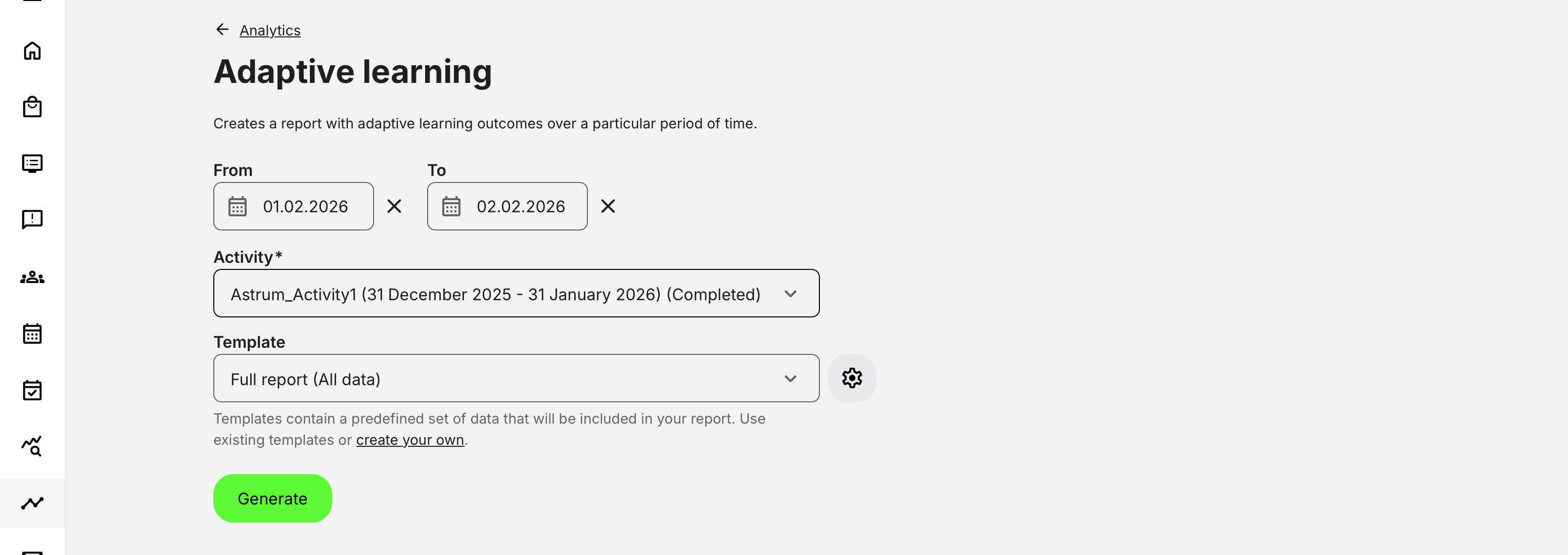
Common Adaptive Triggers Reflected in the Report
Adaptive conditions may be based on triggers such as:
- Test or assessment scores
- Specific answers to test questions
- Completion of prior modules
- Certificates earned
- Events attended
- SCORM, H5P, or xAPI results
- Job function
- Organization or sub-organization
- Combined AND / OR rule sets
When conditions are met, the report reflects:
- Path changes
- Progress recalculations
- Optional or skipped modules
- Completion outcomes influenced by adaptation
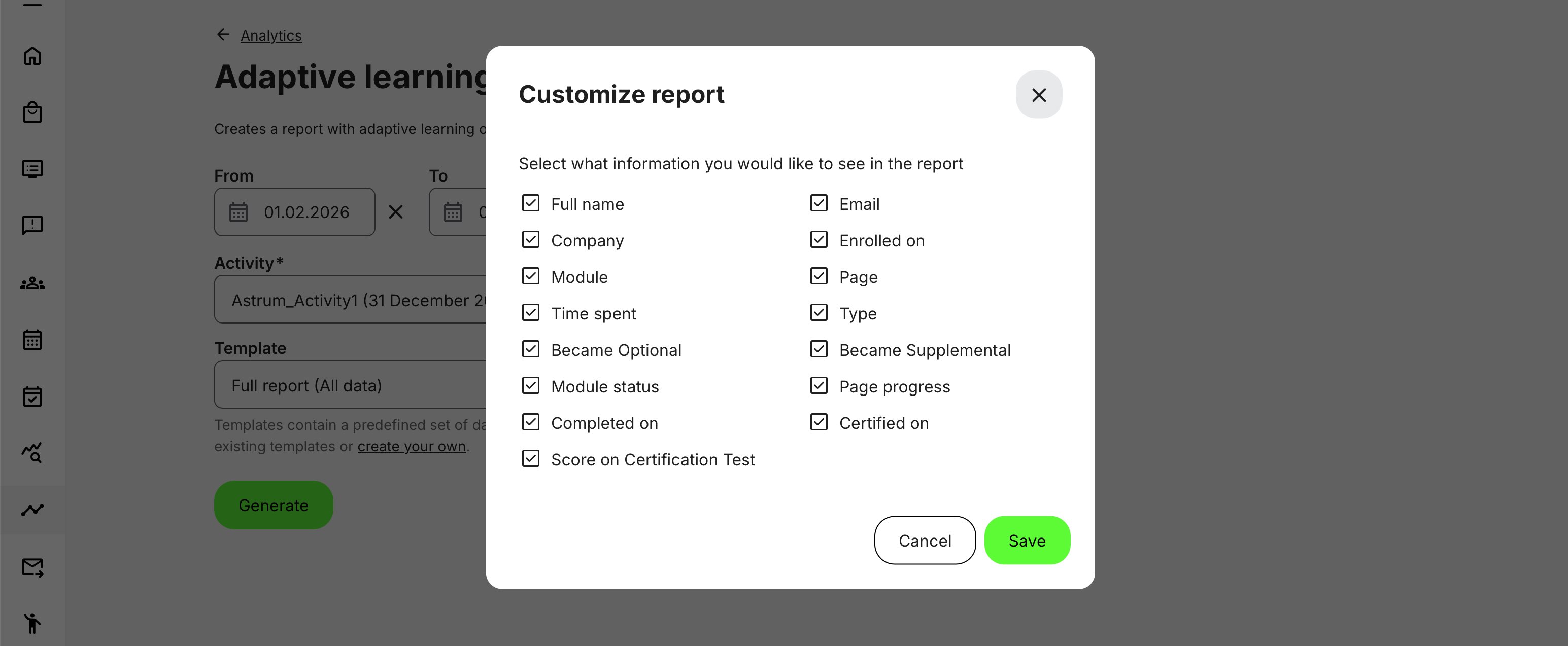
What’s Included in the Adaptive Learning Report
The Adaptive Learning report provides learner-level and path-level insight into adaptive behavior. Depending on configuration and permissions, the report typically includes:
| Context | Data output |
|---|---|
| Learner and context data |
|
| Adaptive learning path data |
|
| Performance and progress metrics |
|
| Timeline indicators |
|
This structure allows administrators to analyze both individual learner journeys and aggregate patterns across cohorts.
Interpreting Progress and Completion in Adaptive Learning
One of the most important aspects of this report is understanding why progress differs between learners. Adaptive behavior affects reporting in the following ways:
- Hidden modules do not count toward progress
- Optional modules may be skipped without blocking completion
- Excluded modules (“Do not count progress”) appear but do not affect completion
- Progress percentages are recalculated dynamically based on the learner’s adaptive path
This ensures that reported completion reflects learning relevance rather than rigid curriculum structures, making it possible to evaluate outcomes based on content design decisions and adaptive learning journeys—and to assess their real impact on learner progress.
Adaptive Behavior → Reporting Impact (Reference Table)
| Adaptive Behavior | What Happens in Learning | How It Appears in the Report |
|---|---|---|
| Module hidden | Learner never sees module | Module excluded from progress and completion |
| Module becomes optional | Learner may skip module | Progress recalculates without penalty |
| Supplemental module triggered | Extra content added | Appears as additional module activity |
| Remediation path triggered | Learner diverted to support content | Longer completion path visible |
| “Do not count progress” enabled | Module informational only | Visible but excluded from completion metrics |
| Adaptive rule unmet | Standard path continues | No deviation shown |
Using the Report to Evaluate Adaptive Strategy Effectiveness
At scale, the Adaptive Learning report helps administrators and learning designers answer strategic questions such as:
- Are adaptive rules triggering as expected?
- Are learners frequently bypassing specific modules?
- Do adaptive paths reduce time-to-completion?
- Are remediation modules improving outcomes?
- Are advanced learners fast-tracked appropriately?
Patterns in the data can reveal:
- Over-restrictive or under-triggered adaptive rules
- Content that is consistently skipped or overused
- Opportunities to refine thresholds or criteria
- Differences in performance across learner segments
Permissions, Data Access, and Organization Layer
The Adaptive Learning Report is governed by role-based permissions and the organization layer. Users can only see data they are authorized to access based on their role, organizational affiliation, and scope of responsibility.
In practice:
- Data visibility is limited to permitted organizations, activities, and entities
- Parent organizations can see aggregated sub-organization data; sub-organizations cannot see upward or sideways
- Blocked users remain visible for historical accuracy; deleted users are excluded for privacy compliance; Cancelled and expired enrollments remain visible for audit and traceability
- The same rules apply consistently to both on-screen analytics and exported reports
This ensures secure, consistent, and audit-ready access to data across the platform.
Extending Adaptive Learning Analysis Beyond Eurekos
Adaptive Learning often comes with special considerations, and there is an appetite for many interpretations. For advanced or specialized needs, administrators can:
- Export Adaptive Learning reports for external analysis
- Use Eurekos APIs to integrate data into BI platforms
This ensures adaptive learning analytics scale with organizational maturity.