Skills Report - Article
Summary
The Skills Report exports structured data about user skills, including assigned competencies, levels, and expiration status. It helps organizations track capability coverage, validate readiness, and support compliance or workforce development initiatives.
In this article you will learn:
- How the Skills Report tracks competencies assigned to users
- How skill levels and expiration dates appear in reporting
- How skill analytics supports readiness and capability mapping
- How the report supports compliance and workforce planning
Purpose and Scope
Skills in Eurekos represent verified competencies—often earned through certifications, learning paths, or manual assignment—that reflect real-world capability rather than simple course completion. The Skills Report turns this competency model into measurable, auditable data.
The report is designed for administrators, learning owners, partner managers, and compliance stakeholders who need to answer questions such as:
- Who currently holds which skills—and at what level?
- Which skills are expiring or require re-certification?
- How do skills distribute across teams, regions, or partner organizations?
- Are learners progressing toward the expected competence profiles?
- Can we document skills coverage for audits, accreditation, or partner readiness?
Unlike analytics views that emphasize trends and current status, the Skills Report focuses on exportable, record-level evidence—making it suitable for audits, governance, workforce planning, and integration with external BI or HR systems.
What the Skills Report Covers
The Skills Report consolidates all skill-related data recorded on the platform, regardless of how the skill was obtained:
- Skills earned through certificates and learning paths
- Skills assigned manually by administrators
- Skills with levels, expiration dates, and renewal requirements
- Skills linked to compliance, accreditation, or partner enablement
Each row in the report represents a user–skill relationship, enriched with contextual metadata.
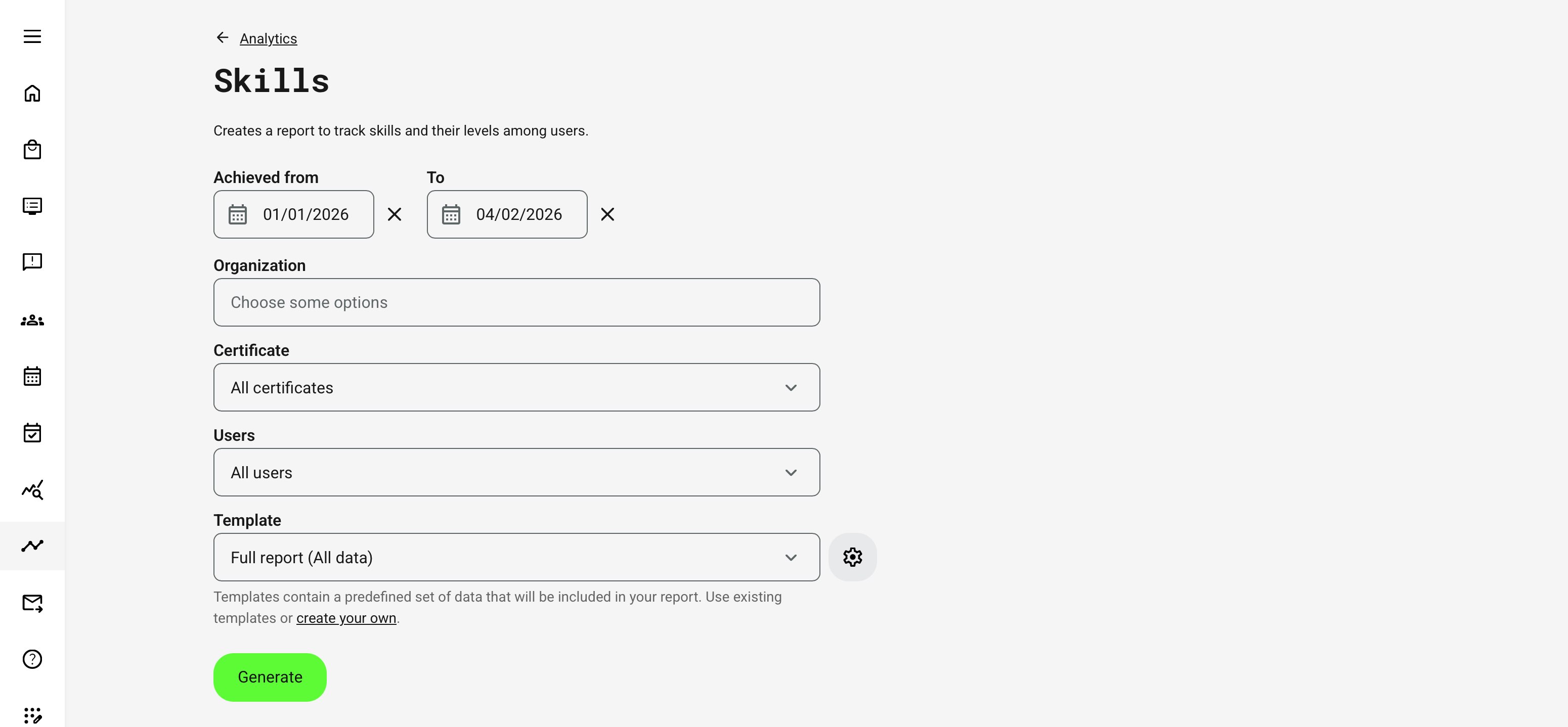
Skills Report – Report Form and Filters
The Skills Report form lets administrators define which skill records are included in the export and how the data is structured.
- Achieved from / To: Filters skills by the date they were issued. Only skills achieved within the selected period are included. Clearing the dates includes all historical records
- Organization: Limits the report to one or more organizations or sub-organizations. If left blank, all accessible organizations are included, respecting the organization layer and permissions
- Certificate: Filters skills by the certificate that granted them. If no certificate is selected, skills from all certificates are included. Deleted or removed certificates cannot be selected
- Users: Restricts the report to specific users (name/email). If left blank, skills for all users within scope are included
You can use the full report or select a custom template to tailor the output for your needs, or customize the report on the fly for a one-time export.
Skills Report – Data Fields and Structure
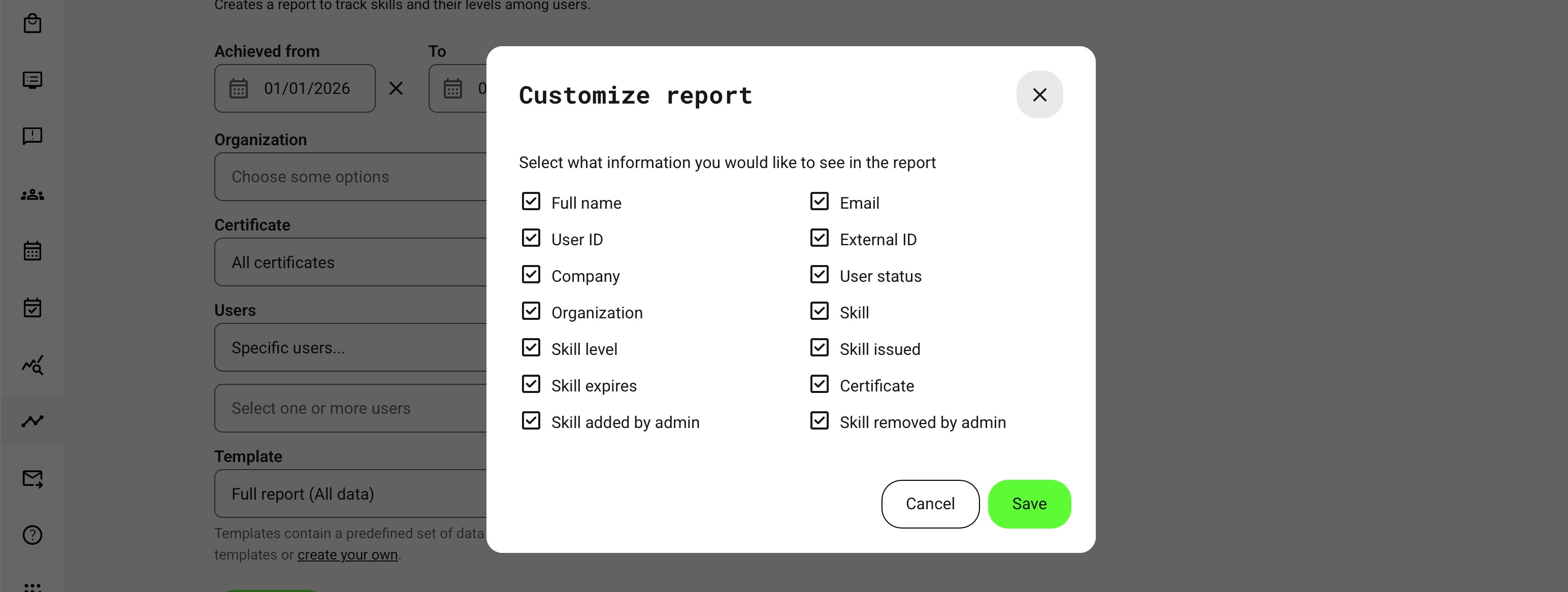
The Skills Report is exported as a structured, row-based file. The exact columns may vary slightly depending on platform configuration, but the report typically includes the following:
| Field | Description |
|---|---|
| User full name | Name of the user holding the skill |
| User’s email address | |
| User ID | Internal Eurekos user identifier |
| External ID | External HR / CRM identifier (if configured) |
| User Status | User's status such as Active or Blocked |
| Organization | Organization or sub-organization at time of skill assignment |
| Company | User’s Company (profile-based) |
| Skill name | Name of the skill |
| Skill level / points | Numeric value or level weight (where applicable and if configured) |
| Certificate name | Certificate granting the skill (if applicable) |
| Skill issued | Date the skill was granted |
| Skill expiration | Date the skill expires (if configured) |
| Assigned by | Date if skill is added by Administrator |
| Removed by | Date if skill is removed by Administrator |
Structural notes:
- One row represents one skill per user
- Users with multiple skills or multiple levels appear on multiple rows
- Expired skills remain visible for historical and audit accuracy
- Date fields are timezone-aware and audit-safe
Permissions, Data Access, and Organization Layer
The Skills Report is governed by role-based permissions and the organization layer. Users can only see data they are authorized to access based on their role, organizational affiliation, and scope of responsibility.
In practice:
- Data visibility is limited to permitted organizations, activities, and entities
- Parent organizations can see aggregated sub-organization data; sub-organizations cannot see upward or sideways
- Blocked users remain visible for historical accuracy; deleted users are excluded for privacy compliance; Cancelled and expired enrollments remain visible for audit and traceability
- The same rules apply consistently to both on-screen analytics and exported reports
This ensures secure, consistent, and audit-ready access to data across the platform.
Real-World Use Case: Partner Readiness and Compliance
A global organization operates a partner certification program across multiple regions. Partners must demonstrate verified skills in product knowledge, safety procedures, and regulatory compliance before being authorized to sell or support solutions.
Using the Skills Report, program administrators can:
- Export a list of partners who currently hold required skills
- Identify partners with expired or soon-to-expire competencies
- Validate that certification-driven skills are evenly distributed across regions
- Provide audit-ready documentation to regulators or accrediting bodies
- Support commercial decisions such as partner tiering, discounts, or eligibility
Because skills may expire independently of course completion, the Skills Report provides a more accurate readiness signal than completion data alone.
Use Case: Skills as Effort-Based Qualification and Ongoing Accreditation
Some organizations use skills and skill levels as a proxy for effort or learning hours, rather than as purely qualitative capability indicators. In this model, each skill represents a defined area of qualification, and the level or value assigned to the skill reflects the effort invested—such as learning time, completed activities, or earned credits.
By combining multiple skills, organizations can define qualification profiles that represent the expected knowledge mix for a role, consultant, or partner. For example, a consultant may be required to maintain a balanced set of skills across product knowledge, regulatory updates, and industry best practices—each contributing a portion of the total required effort for the year.
When skills are linked to certificates with expiration rules, this approach becomes a powerful alternative to traditional credit systems. As certificates expire, the associated skills and levels are reduced or removed, signaling that knowledge is no longer current. Consultants must then re-earn skills through updated training to remain eligible.
This model is particularly effective for:
- Consulting organizations with annual knowledge maintenance requirements
- Regulated industries where ongoing competence must be demonstrated
- Partner ecosystems where eligibility depends on continuous learning effort
- Framework-driven accreditation models that emphasize renewal over permanence
Using the Skills Report, administrators can track who has accumulated the required mix of skills, who is at risk due to expiring qualifications, and whether consultants meet the minimum effort thresholds needed to represent the organization or operate under a given framework.
The result is a transparent, effort-based accreditation model that balances flexibility with accountability—ensuring that qualifications reflect current, relevant knowledge rather than static, historical achievements.