Certificates Analytics & Reporting - Article
Summary
Certificates analytics and reporting provides insight into how certifications are earned, issued, expired, and maintained. It supports qualification tracking, compliance monitoring, accreditation reporting, and audit-ready oversight across certification-based learning programs.
In this article you will learn:
- How Certificates analytics tracks issuance, expiry, and renewal outcomes
- How certification data supports compliance and accreditation oversight
- How to identify performance patterns and bottlenecks in certification paths
- How certification reporting supports audit-ready documentation
Why Certificates Matter
Certificates in Eurekos represent more than course completion. For many organizations, they are proof of qualification, regulatory compliance, or professional standing. In customer training, partner programs, and accredited education, certificates often represent the actual product being sold—granting learners the right to operate, advise, or represent a brand or standard.
Certificates Analytics is therefore designed to answer critical questions such as:
- Are learners earning the certifications they are eligible for?
- How long does it take to become certified?
- Which activities, certificates, or organizations perform best?
- Where are learners getting stuck or failing to complete certification paths?
- Are certifications being revoked, expired, or reissued correctly?
By combining visual analytics with auditable reports, Eurekos supports both day-to-day operational oversight and formal compliance or accreditation requirements.
What Certificates Analytics Covers
Certificates Analytics provides an overview of issued certificates within a selected time period, viewed from multiple perspectives:
- By Activity (courses, programs, learning paths)
- By Certificate (individual credentials)
- By Organization (customers, partners, departments)
- Over time, including certification velocity and trends
If a user earns and re-earns the same certificate within the selected period, only the latest issuance is counted, ensuring accurate, non-inflated analytics.
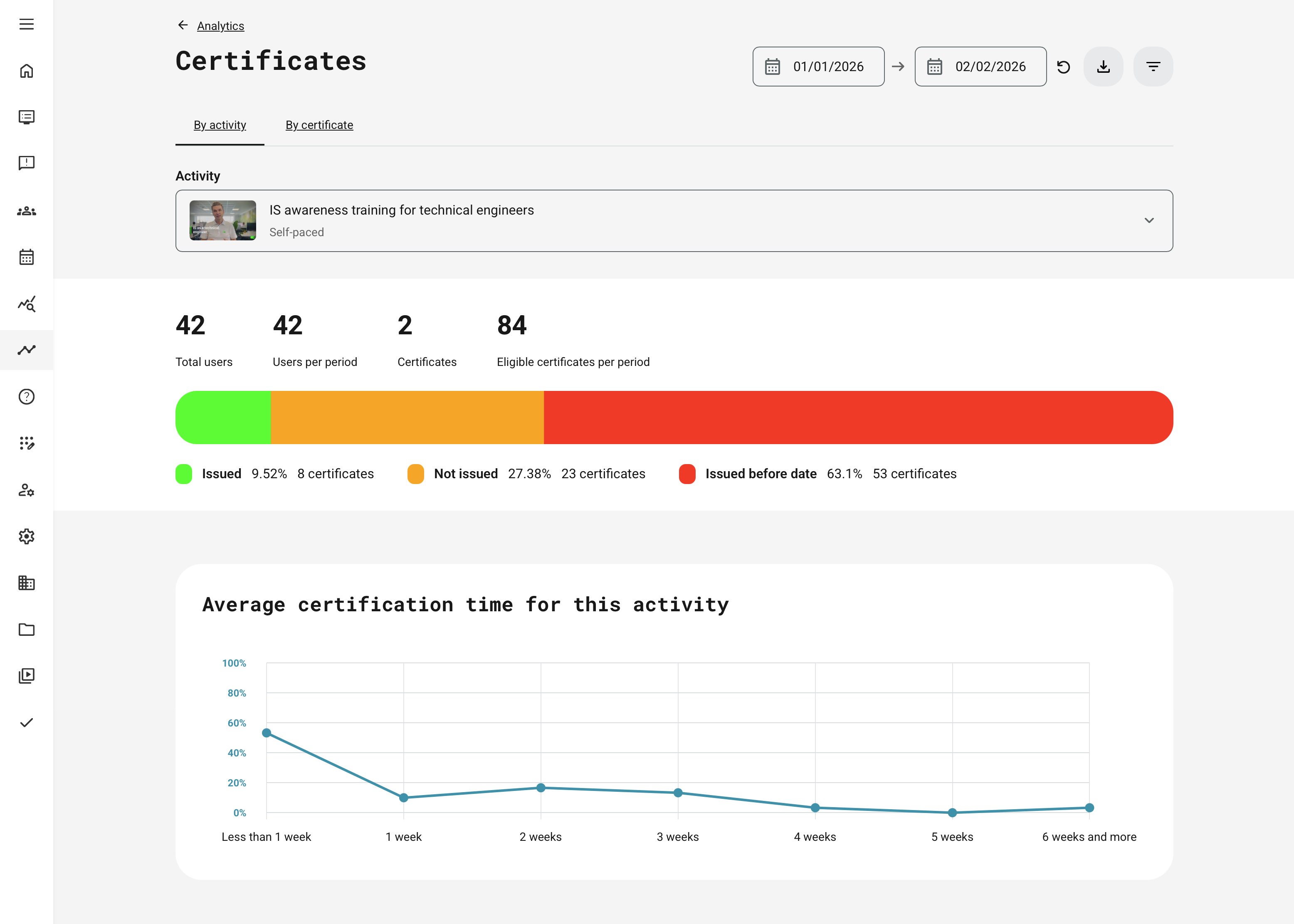
Analytics Views and Structure
Refer to this comparison table to quickly understand what each perspective answers, and when to use which view depending on business focus – certification, compliance, or performance goals.
| View | What It Focuses On | Key Insights Provided | Especially Valuable For |
|---|---|---|---|
| Activity | Certification performance within a specific training activity |
|
|
| Certificate | Performance of a specific certificate across all activities where it is used |
|
|
| Most Certified | Comparative certification success across the platform |
|
|
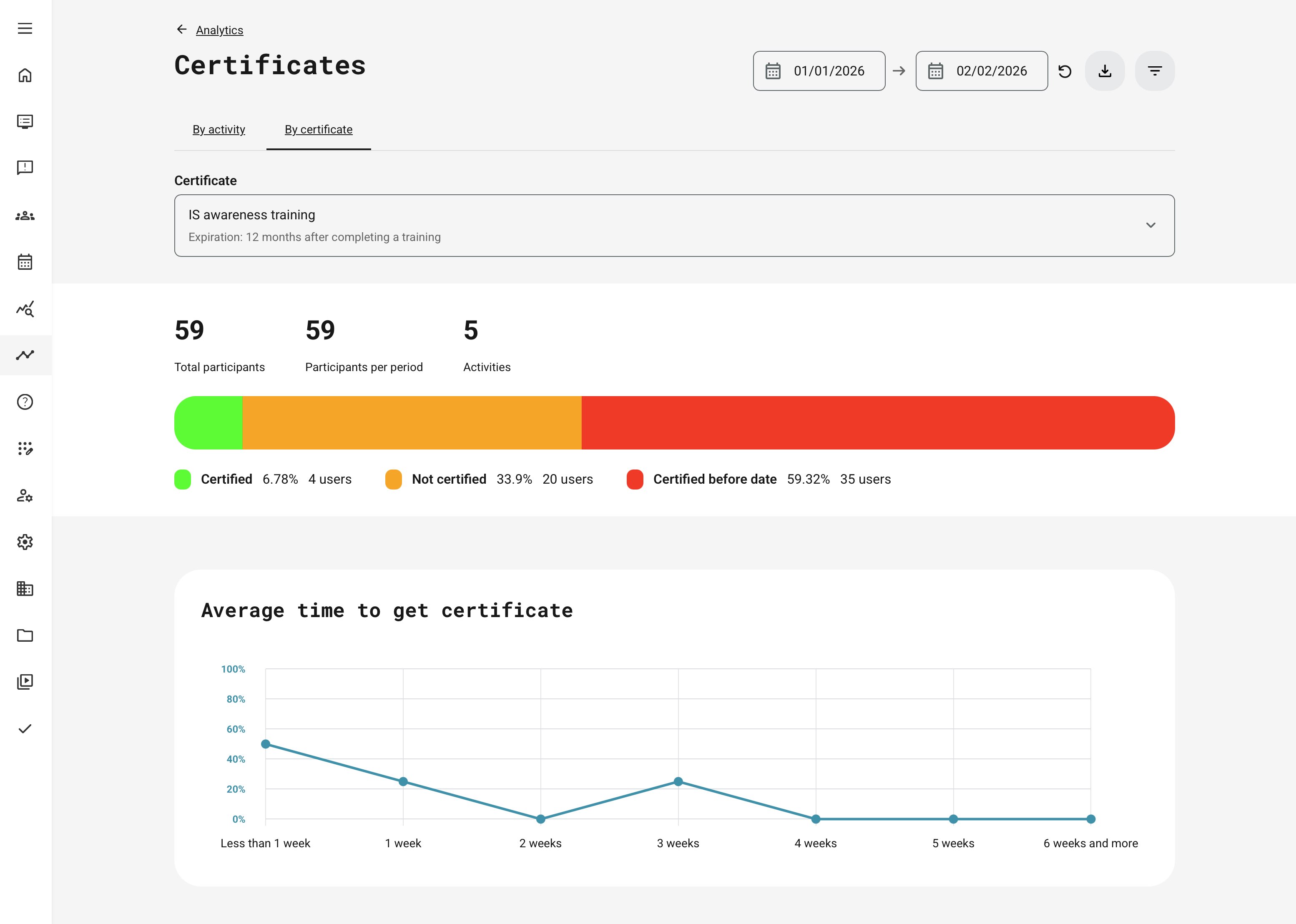
Understanding Certification Metrics
Certificates Analytics helps you understand not just how many certificates are issued, but how certification journeys actually perform. By distinguishing between eligible and issued certificates, you can identify drop-off points, restrictive rules, or incomplete learning paths. Average certification time shows how long learners take to earn credentials end to end, highlighting efficiency and potential friction. With filters across activities, certificates, organizations, regions, and more, the data stays relevant, authorized, and audit-ready—while preserving historical accuracy, even for deleted organizations.
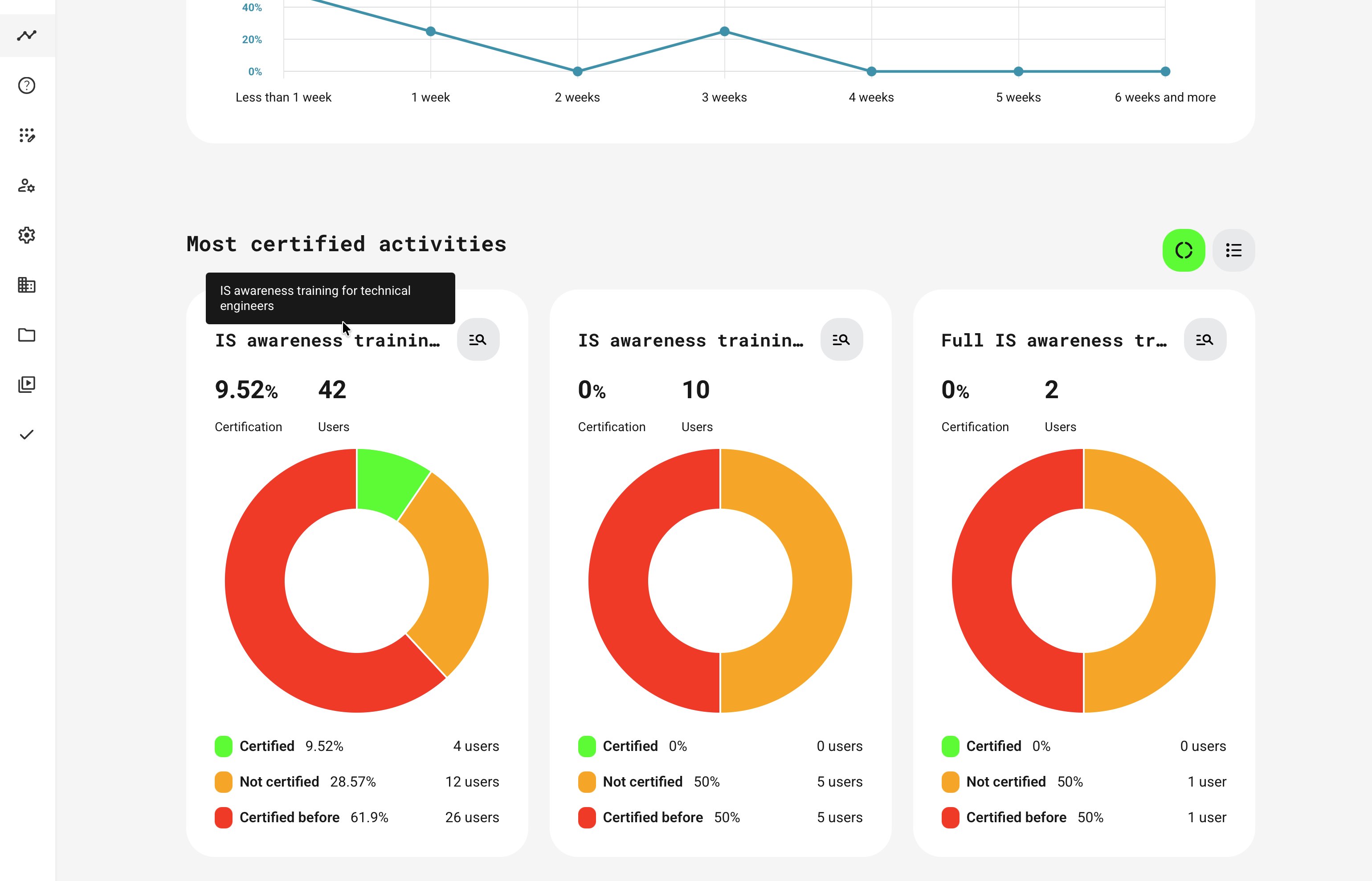
Combined with flexible filtering by activity, certificate, organization, country, language, and category, these metrics allow for precise, authorized, and context-aware analysis—while preserving historical accuracy by retaining deleted organizations for long-term reporting and audit purposes.
| Metric | What It Measures | How to Interpret It |
|---|---|---|
| Eligible Certificates | The number of learners who meet the criteria to earn a certificate | Indicates the potential certification volume based on current rules and prerequisites |
| Issued Certificates | The number of learners who have actually received the certificate | Reflects completed certification outcomes |
| Eligibility vs. Issuance Gap | The difference between eligible and issued certificates at a given point in time | Should be interpreted together with Average Certification Time. A gap may simply indicate learners progressing through requirements, not failure. Persistent or growing gaps over time may point to drop-off, overly complex certification paths, or restrictive rules |
| Average Certification Time | The time from learning start to final certificate issuance | Provides context for certification progress, helping distinguish normal in-progress behavior from inefficiencies or friction in the certification journey |
This framing encourages administrators to view certification analytics as dynamic progress indicators, not just final outcomes—supporting more accurate analysis and better design decisions.
Filters and Segmentation
Certificates Analytics supports filtering such as:
- Activity
- Certificate
- Organization
- Country
- Language
- Category
Filters dynamically affect all views and ensure that:
- Administrators see only data they are authorized to access
- Organizational and regional reporting remains accurate
- Comparative analysis is meaningful and contextual
Deleted organizations remain visible (marked as [DELETED]) to preserve historical accuracy, ensuring long-term auditability.
From Analytics to Reports
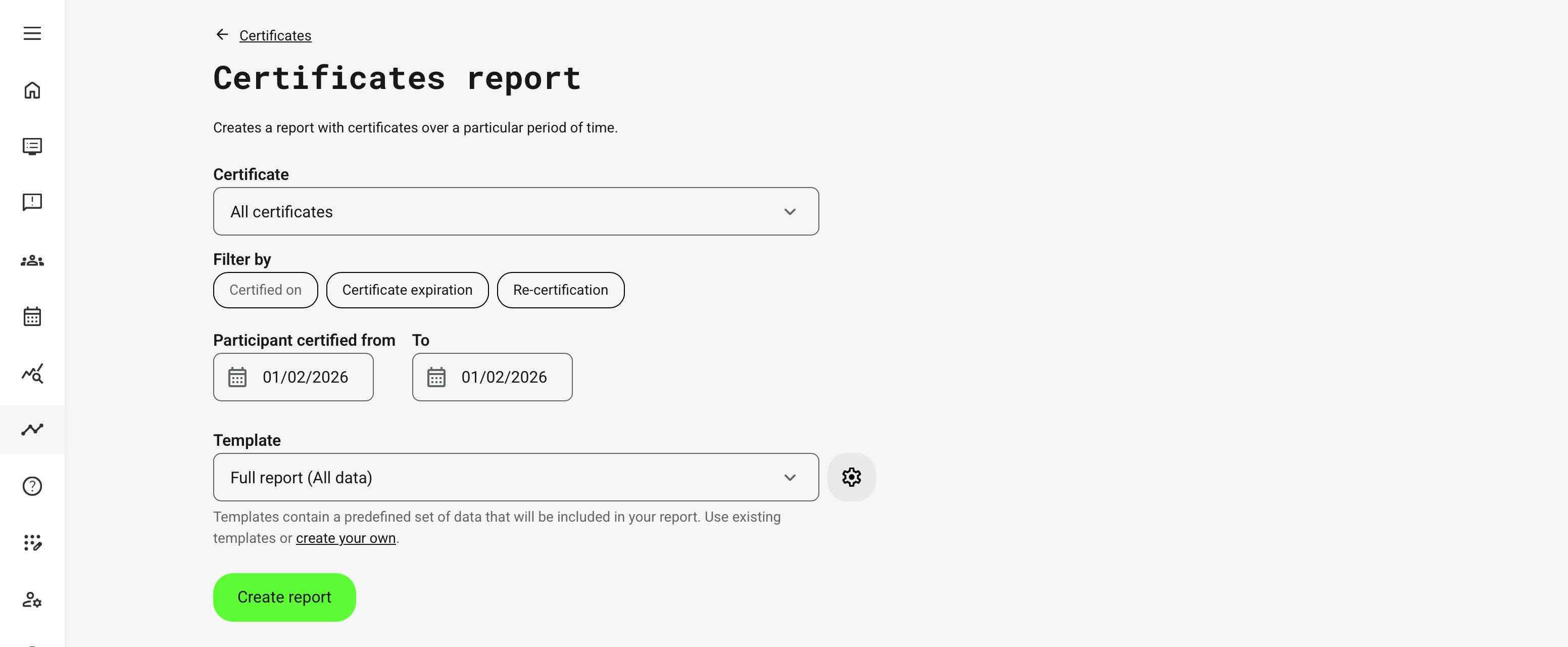
While analytics dashboards answer “How are certifications performing?”, reports answer “Who earned what, when, and under which conditions?”. The Certificates Report provides a detailed, exportable dataset including:
- User identity and organizational context
- Certificate name and type
- Activity source
- Issue date and expiration
- Certification status (issued, expired, revoked)
This report is essential for:
- Compliance audits
- Accreditation reviews
- External reporting to regulators or partners
- Financial reconciliation in commercial training programs
Use the download icon in the analytics overview to generate a report.
Certificate Revocation and Lifecycle Logic
Certificates Analytics and Reports reflect certificate lifecycle rules consistently:
- Expired certificates remain included for historical accuracy
- Revoked certificates are excluded when revoked due to attendance or assessment reversal
- Deleted users are excluded
- Blocked users remain included
- Re-certifications replace earlier attempts in analytics views
This ensures analytics always reflect valid certification states, while reports retain traceability.
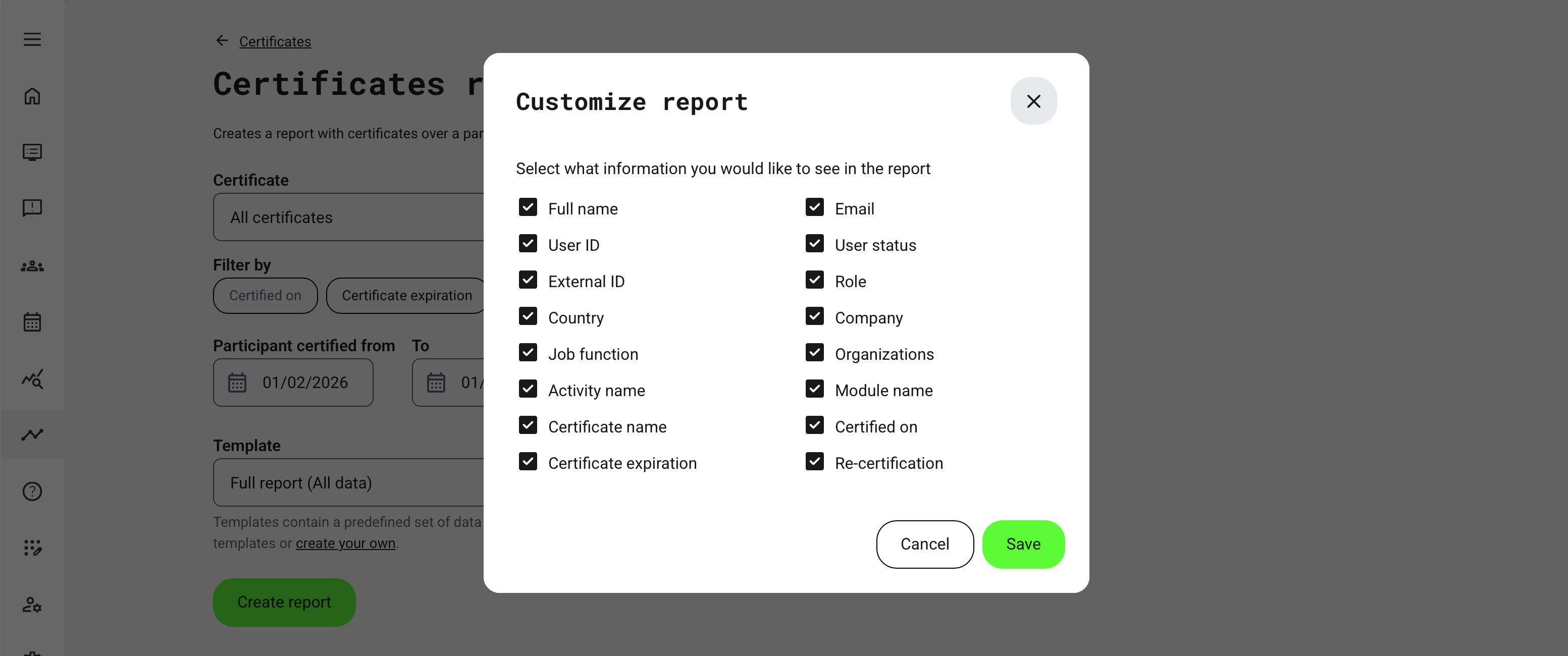
Certificates Report – Data Field Reference Table
The Certificates Report provides a detailed, auditable dataset for certification outcomes. Each row represents a certificate-related event tied to a learner, activity, and organizational context. As with all reports, available data fields may depend on configuration.
| Field | Description |
|---|---|
| User ID | Internal unique identifier for the user |
| First name | User’s first name at time of certification |
| Last name | User’s last name at time of certification |
| User’s email address | |
| Organization | Organization the user belonged to at the time of certificate issuance |
| Sub-organization | Sub-organization, if applicable |
| Certificate name | Name of the issued certificate |
| Certificate type | Type of certificate (e.g. completion, accreditation, compliance) |
| Activity title | Training activity where the certificate was earned |
| Activity ID | Unique identifier of the activity |
| Activity type | Course, program, learning path, etc. |
| Issued date | Date the certificate was issued |
| Expiration date | Certificate expiration date (if applicable) |
| Certificate status | Issued, expired, or revoked |
| Issued by | System or rule responsible for issuing the certificate |
| Completion date | Date the learner completed the final required step |
| Language | Language context of the activity |
| Country | User’s country (based on profile data) |
| Created at | Timestamp when the certificate record was created |
| Updated at | Timestamp of the latest certificate status change |
This report is typically used for audits, accreditation evidence, partner reporting, and commercial documentation.
Permissions, Data Access, and Organization Layer
Certificate Analytics and Reports are governed by role-based permissions and the organization layer. Users can only see data they are authorized to access based on their role, organizational affiliation, and scope of responsibility.
In practice:
- Data visibility is limited to permitted organizations, activities, and entities
- Parent organizations can see aggregated sub-organization data; sub-organizations cannot see upward or sideways
- Blocked users remain visible for historical accuracy; deleted users are excluded for privacy compliance; Cancelled and expired enrollments remain visible for audit and traceability
- The same rules apply consistently to both on-screen analytics and exported reports
This ensures secure, consistent, and audit-ready access to data across the platform.
Certificates, Evidence, and Audit Readiness
Eurekos is designed to support organizations operating in regulated and professionally accredited learning environments, where formal proof of competence, participation, and compliance is required.
Issued certificates are not simple acknowledgements of course completion. They are governed credentials generated through defined rules, validated learning outcomes, and auditable data trails. Each certificate is tied to a specific learner, activity, organizational context, and issuance event, ensuring traceability and accountability at every stage.
The platform supports:
- Rule-based certificate issuance, aligned with regulatory or professional standards
- Time-bound validity, including expiry and re-certification logic
- Full audit history, capturing when and how certificates were issued, updated, expired, or revoked
- Organizational context, preserving the learner’s organizational affiliation at the time of certification
- Scalable reporting, enabling both real-time oversight and formal historical audits
All certificate data can be accessed through built-in analytics dashboards for monitoring and through structured reports suitable for external audits, accreditation reviews, and regulatory submissions.
Importantly, historical accuracy is maintained. Certificates remain reportable even if users or organizations change or are deleted, ensuring long-term evidence integrity—a critical requirement in regulated industries.
Example Audit Workflow: ISO (Quality & Compliance Standards)
An organization must demonstrate that employees and partners are trained, competent, and certified in accordance with ISO standards (e.g. ISO 9001, ISO 27001, ISO 13485).
Typical Audit Questions
- Who was certified during the audit period?
- Which training activities led to certification?
- Were certifications valid at the time of operation?
- Can we prove consistency and governance in training delivery?
| Step | Audit Intent | What Happens in Eurekos |
|---|---|---|
| 1 | Define scope and requirements | Certificates are configured and linked to specific courses or learning paths aligned with ISO standards (e.g. ISO 9001, ISO 27001). Validity periods and re-certification rules are defined |
| 2 | Ensure controlled delivery | Learners enroll in governed activities. Completion rules, prerequisites, and eligibility logic are enforced automatically by the LMS |
| 3 | Prove competence | Certificates are automatically issued when learners meet all defined requirements. Issuance is time-stamped and linked to learner identity |
| 4 | Maintain ongoing visibility | Use Certificates Analytics dashboards to track issuance rates, coverage, and upcoming expirations |
| 5 | Prepare audit evidence | Administrators generate Certificates Reports filtered by date range, organization, department, or certificate type (e.g. compliance, quality, privacy, safety) |
| 6 | Validate traceability | Reports include learner identity, activity title, completion date, certificate issue date, validity period, and organizational context at issuance |
| 7 | Demonstrate governance | Reports are exported as structured data and used as formal audit evidence, supported by analytics screenshots showing ongoing oversight |
Audit outcome → Clear proof that certification is systematic, governed, and continuously monitored, meeting ISO documentation and traceability requirements.
Example Workflow – Healthcare & Regulated Training
Healthcare organizations must demonstrate that clinicians, nurses, and medical staff hold valid certifications tied to patient safety, regulatory compliance, and professional standards.
Typical Audit Questions
- Are all clinicians certified for the procedures they perform?
- Were certifications valid at the time of patient interaction?
- How are expirations, renewals, and compliance gaps managed?
| Step | Audit Intent | What Happens in Eurekos |
|---|---|---|
| 1 | Define mandatory training | Clinical or compliance certificates are linked to required activities or learning paths for specific roles, units, or organizations (e.g. Clinical procedures, medical devices or regulatory mandates such as safety and treatment protocols) |
| 2 | Enforce participation | Enrollment, attendance, and completion requirements are governed centrally to ensure mandatory training is completed |
| 3 | Validate authorization to operate | Certificates are issued automatically upon completion and include validity periods aligned with regulatory requirements |
| 4 | Monitor compliance status |
|
| 5 | Identify risk and exceptions |
|
| 6 | Produce inspection-ready reports |
|
| 7 | Preserve historical accuracy | Certifications remain visible even if users or organizations change, supporting long-term regulatory traceability |
Audit outcome → The organization can prove that only appropriately certified staff are authorized, and that compliance is actively enforced—not retrospectively reconstructed.
Example Workflow – CE / CPD / Professional Accreditation
Organizations delivering Continuing Education (CE) or Continuing Professional Development (CPD) operate in an environment where learning is directly tied to license renewal, professional standing, and ongoing eligibility to practice. This applies across industries such as engineering, finance, legal services, energy, healthcare and regulated technical professions.
In this context, certificates are not optional—they represent formal proof of learning activity, credit accumulation, and compliance with external requirements defined by professional bodies, accrediting councils, or regulators.
Typical Accreditor or Regulator Questions
- How many CE credits were issued during the reporting period?
- Which professionals earned which credits, and for which activities?
- Were credits awarded in accordance with approved learning structures?
- Can credit history be traced across multiple years?
- How are expirations, renewals, and re-certification managed?
In several cases certificates directly mirror CE credits (CEU points) → focus on topic specific certificates.
| Step | Audit / Accreditation Intent | What Happens in Eurekos |
|---|---|---|
| 1 | Define accreditation framework | Certificates (or CEU-aligned credentials) are associated with activities, learning paths, or skills, including point values where applicable:
|
| 2 | Deliver accredited learning | Learners complete accredited activities according to defined learning journeys and assessment rules |
| 3 | Issue credentials or credits |
|
| 4 | Track progression and outcomes |
|
| 5 | Monitor program effectiveness | Analytics identifies which programs, partners, or organizations achieve certifications most effectively. Using Certificates and Progress Report, administrators can:
|
| 6 | Support learner documentation | Reports provide learners and partners with verifiable proof of earned credentials |
| 7 | Report to accrediting bodies | Structured reports are exported for accrediting organizations, partner reporting, or external record keeping |
Audit Outcome → For CE and CPD scenarios, Eurekos enables organizations to prove that:
- Credits are awarded based on validated learning activity
- Certification rules align with accreditor standards
- Credit histories are accurate, complete, and traceable over time
- Professionals receive reliable documentation for license renewal and career progression
The result is a compliance-ready CE ecosystem, where learning delivery, credit management, and audit evidence are fully aligned—reducing administrative burden while increasing trust with regulators and accrediting bodies.
In simplicity:
A professional engineering body requires members to document 40 CE credits per year to maintain active licensure.
Using Eurekos, the training provider can:
- Deliver CE-approved learning programs
- Automatically issue certificates with embedded credit values
- Track individual and aggregate certificate/credit accumulation
- Provide annual certificate/credit reports for both members and the accrediting body
- Demonstrate governance, consistency, and auditability across all CE activity
Depending on the complexity of the program, this might be one or several reports to aggregate this as needed/in the required format.
Creativity on the topic: A flexible alternative for managing CE/CEU points is to use Skills as the underlying mechanism. Skills can be awarded, aggregated, and expired through certificates, making them suitable for many accreditation scenarios.
This approach is especially useful when an accrediting body requires different point types or categories. By applying distinct tags to skills, you can model multiple point structures—such as clinical, technical, or regulatory credits—while maintaining similar behavior to traditional CE tracking. Reporting will differ from certificate-based reporting, but the underlying logic remains consistent.
Because nearly everything in Eurekos can be renamed, translated, and adapted, you can align this setup with your accreditation terminology and requirements. This makes skills a powerful option when you need advanced segmentation of points without introducing a separate or parallel system.
Certificates vs Attendance vs Completion Analytics
The purpose of the comparison table is to clarify that these metrics answer different questions about learning—and that none of them should be interpreted in isolation. Certificates is the generic “go-to” report, and while they are often confused or treated as interchangeable, each represents a distinct level of validation and intent:
- Attendance confirms presence — that a learner showed up to a session or event
- Completion confirms activity progress — that required learning steps were finished
- Certificates confirm achievement or recognition — that defined criteria, standards, or outcomes were met
The comparison table helps administrators, auditors, and learning owners understand when to use each metric, what business or compliance question it answers, and how they work together. This is especially important in regulated, professional, partner, or revenue-driven training contexts, where proof of participation alone is insufficient and formal recognition carries legal, commercial, or career impact.
Used together, these dimensions provide a complete picture—who attended, who completed, and who actually earned recognition—supporting accurate reporting, audits, and strategic learning decisions.
| Aspect | Certificates Analytics | Attendance Analytics | Completion / Progress Analytics |
|---|---|---|---|
| Primary focus | Credentials and qualifications | Participation in events or sessions | Learning progress and completion |
| Typical use cases | Compliance, accreditation, CE, partner programs | Instructor-led training, events, seminars | Course effectiveness, learner progress |
| Business criticality | Very high (often the product itself) | Medium–high (proof of presence) | High (learning effectiveness) |
| Lifecycle tracking | Issued, expired, revoked, reissued | Attended, missed, marked | Started, in progress, completed |
| Audit suitability | Excellent | Good | Good |
| Detailed reports | Yes | Yes | Yes |
| External validation | Common (regulators, accrediting bodies) | Occasional | Rare |
| Automation level | High (rule-based issuance) | Medium (manual or semi-automatic) | High |
Certificates Analytics & Reporting – Glossary
| Term | Meaning |
|---|---|
| Certificate | A formal credential issued upon meeting defined learning requirements |
| Eligible certificate | A certificate that a learner qualifies for based on enrollment and progress |
| Issued certificate | A certificate that has been successfully granted |
| Expired certificate | A certificate that is no longer valid after its expiry date |
| Revoked certificate | A certificate withdrawn due to rule changes, attendance reversal, or invalidation |
| Certification time | Time taken from learning start to certificate issuance |
| Re-certification | Issuance of the same certificate again after expiry or renewal requirements |
| Certification path | The set of activities, modules, or rules required to earn a certificate |
| Compliance certificate | Certificate used for regulatory or legal compliance |
| Accreditation | Formal recognition tied to external or professional standards |
| Audit trail | Historical record of certificate issuance and changes |
FAQ
-
What happens when a certificate earned through event attendance expires?
When a certificate expires — or enters its re-certification window — a new attempt is created.
In the new attempt:
- The certificate is no longer shown
- Progress is recalculated
- The user must meet the criteria again to complete the activity
-
Why is a certificate issued, but the activity still shows “In progress”?
If an activity has both a certificate and an end date, the certificate can be issued immediately once criteria are met, but the activity only shifts to Completed after the end date has passed.
-
What if the end date has passed, but the certificate is not earned yet?
The user remains In progress until the certificate requirements are fulfilled.
-
If a certificate requires “course completion,” when is it issued?
The certificate is issued only after:
- Course content is completed
- Any required end date has passed
Both conditions must be satisfied.
-
If a user has already earned a certificate and the course is later changed, what happens?
The certificate remains valid for the user, but:
- Progress status may revert to Not started or show a different progress percentage.
- Completion is recalculated based on the updated course configuration